


Anh Mai fish-farming hamlet and a legacy of over half a century
A small neighborhood with a beautiful name, Anh Mai 3 (Sunshine) Residential Group, is also known as the famous “fish hamlet” of Ward 3 Bao Loc, with more than 50 years of devotion to tilapia farming.
Turning hardship into advantage
“My father-in-law was among the first to raise fish in Anh Mai. Back then, there were no excavators. People dug ponds with hoes and shovels, lifting every bucket of soil by hand to create fish ponds,” recalled Le Nguyen Hai Linh, head of the Anh Mai 3 Fish Farming Cooperative. Her father-in-law, Mr. Hoang Van Liet, was one of the pioneers who transformed the low-lying land into the aquaculture ponds.
Anh Mai 3 was originally a depressed area that flooded whenever it rained. With its rocky and nutrient-poor soil, crop cultivation was nearly impossible. Faced with these hardships, the early settlers pivoted to aquaculture, harnessing the terrain’s natural bowl to farm fish. Through sheer determination, the villagers hand-dug a network of interconnected ponds, laying the foundation for the tilapia husbandry.
Hoang Van Kien, Mr. Liet’s son, remembers that whenever a family dug a pond, neighbors would gather to help. It took the combined effort of dozens of people over many days to complete a single pond. Without such mutual support, it would have been nearly impossible for any household to do it alone.
According to Hai Linh, Bao Loc’s relatively cool climate is not ideal for many tropical fish species. During the cold, dry season, fish grow slowly. Tilapia, however, is hardy, easy to raise, and well-adapted to local conditions.
“Everyone in Anh Mai raises tilapia. We stock the ponds in February and March, and by the year-end—coinciding with the coffee harvest—we bring our fish to market. With dozens of hectares of water surface, our hamlet proudly supplies hundreds of tons of fish annually,” she remarked.
Applying high-tech methods
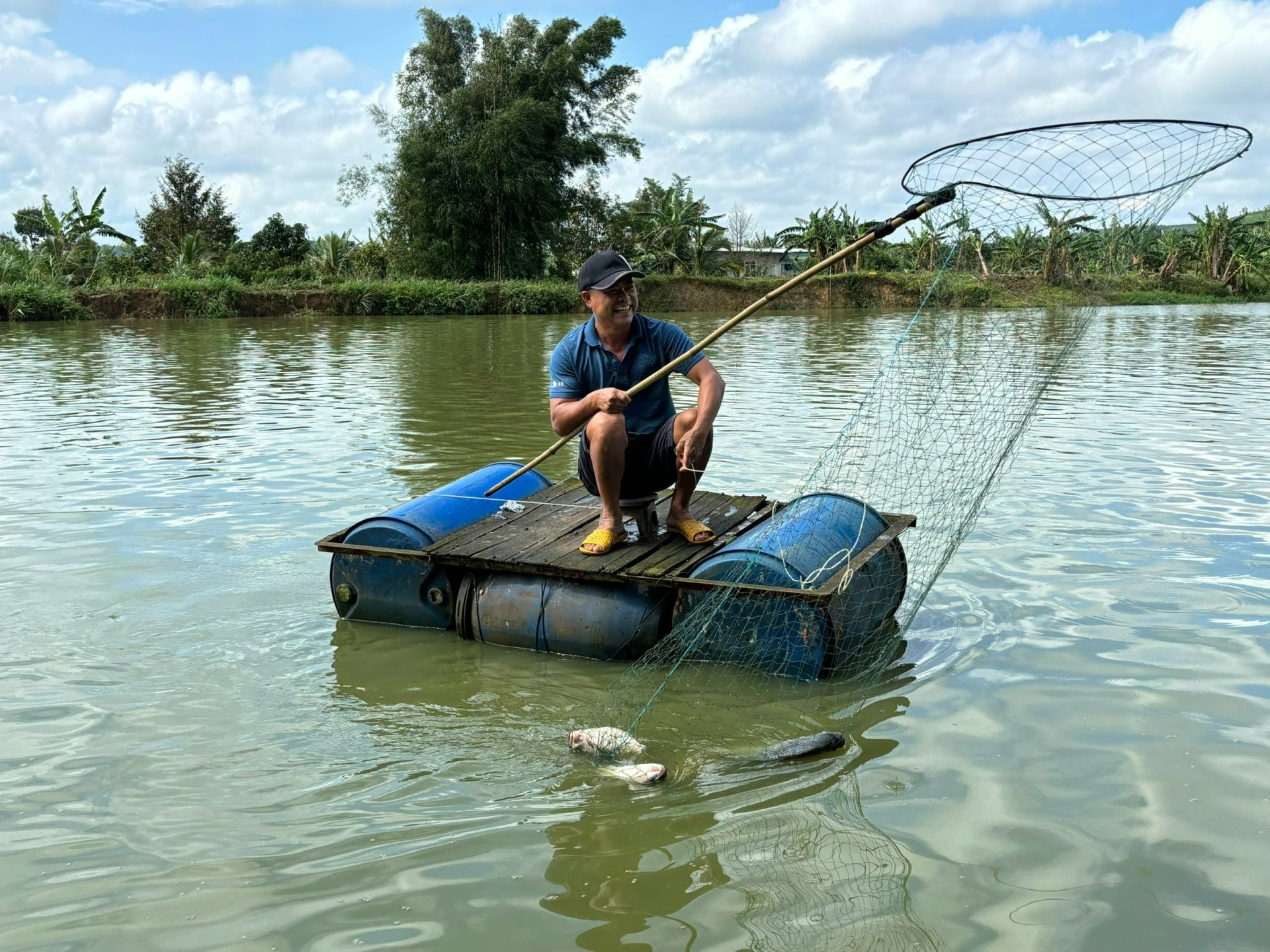
“Fish farming used to be very labor-intensive, but now it’s much easier thanks to technology,” said Nguyen Van Hung, an active member of the cooperative. To protect their earthen ponds from erosion, residents devised an ingenious cable-and-floating platform system. The setup allows feed to be distributed precisely at the center of the pond, preventing bank degradation while improving feeding efficiency.
During the rainy season, the water is naturally clean and well-oxygenated. In the dry season, farmers have installed artificial spray systems to oxygenate the ponds, preventing fish from suffocating. Furthermore, the cooperative members support one another through shared expertise, quality fingerlings, and market connectivity, ensuring both stable and profitable production.
Hung’s family also purchases and distributes fish to households in need of support, guaranteeing stable outlets for Anh Mai tilapia.
Nguyen Thi Tham, Vice Chairwoman of the Farmers’ Association of Ward 3 Bao Loc, noted that a fish-farming hamlet with more than half a century of history that continues to thrive is unique. The residents have inherited the trade from their parents while applying modern techniques and strengthening solidarity to secure stable markets. The model has been highly praised by the provincial Farmers’ Association for its practical effectiveness and for preserving a traditional livelihood in the Central Highlands.