


Creating an OCOP Product from Wild Medicinal Vine Tea
In the remote commune of Cat Tien 2 Commune, located more than 200 km from the provincial center, a Ma ethnic woman has put her own name on the packaging of “Ka Drong Snow Curly Vine Tea,” as a testament to her commitment to the product’s quality.
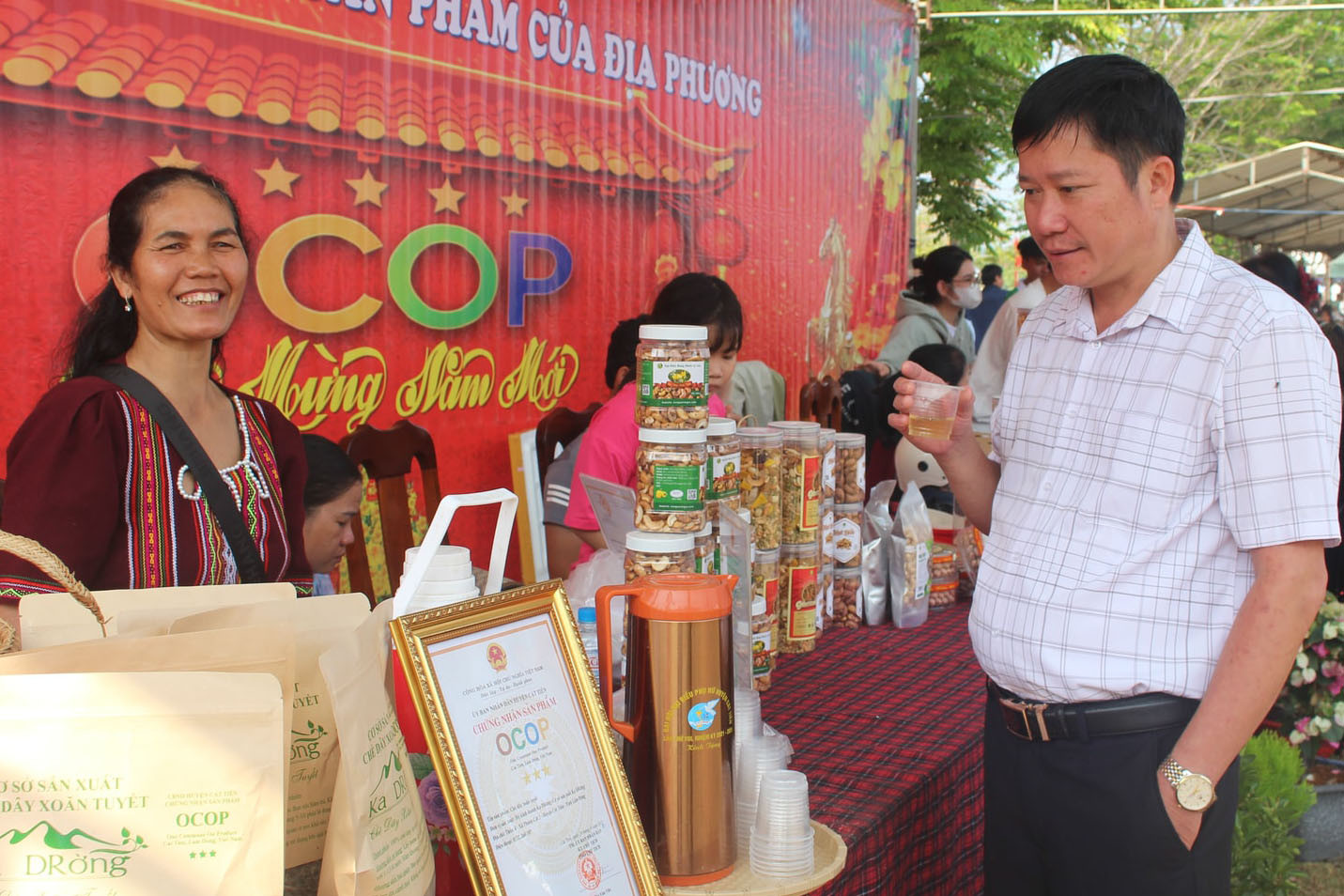
A traditional Ma medicinal herb becomes an OCOP product
Since childhood, Ka Drong (born in 1973) has been given a drink made from the stems and leaves of a wild climbing plant collected from the forest. Under the intense dry-season heat of the Cat Tien basin, the drink helped quench thirst and fatigue, leaving a naturally sweet aftertaste.
About five years ago, during off-farming periods, she began collecting the vines from the forest, drying them, and selling small portions to neighbors in the village and surrounding areas. The tea was well received for its refreshing taste and gentle sweetness. As demand increased, she began harvesting more regularly, selecting fresh green vines with curled leaves that shimmered with a silvery color—hence the name “snow curly vine tea.”
Besides vine tea, she also sells other forest products such as wild leaves, rattan shoots, and sour tamarind, depending on the season. However, vine tea remains the most sought-after item. In 2023, the “Snow Curly Vine Tea” produced by her Ka Drong facility was recognized as a 3-star OCOP product, marking the transition from small-scale trading to branded production with clear labeling and traceable origin.
The vine tea plant grows widely in forest buffer zones around Cat Tien and neighboring areas such as Bu Dang and Bu Dop (formerly in Binh Phuoc Province, now part of Dong Nai Province). For the Ma people, it is a valuable traditional medicinal herb believed to help cool the body, support liver function, act as a diuretic, reduce blood fat, and improve sleep. Thanks to its natural sweetness, the tea requires no additional ingredients.
To maintain supply, she also purchases fresh vines from local forest gatherers and processes them the same day. The raw materials are cleaned, cut into small pieces, and sun-dried under the strong sunlight of Cat Tien to preserve their natural flavor. Properly dried tea has a light brown color with silvery highlights, producing a clear green infusion with a mild aroma.
Bringing forest products to consumers
The tea is currently packaged in 500-gram bags and sold for about VND 100,000, with a shelf life of around six months if stored in a dry place. The product has helped stabilize her family’s income while providing additional earnings for others who collect vines from the forest. Since receiving OCOP recognition, demand has increased significantly, with orders expanding to places such as Dong Nai, Ho Chi Minh City, Quang Ngai, and several northern provinces.
According to Nguyen Van Thuc, Secretary of the Party Committee and Chairman of the People’s Council of Cat Tien 2 Commune, the Ka Drong vine tea facility has enriched the range of local specialties. In the past, vine tea was simply dried and used within households. Once standardized as an OCOP product, its commercial value increased and opened new opportunities linked with rural tourism.
Cat Tien 2 Commune lies near several destinations, including the Cat Tien Archaeological Site, the Zone 6 Revolutionary Base, and Cat Tien National Park. Visitors coming to explore the history and ecosystem are also interested in local specialties, among which Snow Curly Vine Tea offers a unique experience of the Ma people’s traditional use of medicinal plants.
However, because the raw materials are entirely harvested from natural forests, supply remains unstable. As demand rises, more people have begun collecting the vines, making the plant increasingly scarce. Local authorities have therefore encouraged selective harvesting, while avoiding cutting the plant at its roots , or overharvesting it to ensure the species remains in the forest and continues to support livelihoods.
From a traditional household drink of the Ma people, Snow Curly Vine Tea has entered the market as a 3-star OCOP product, demonstrating how a traditional medicinal plant can become a valuable commodity when preserved, processed properly, and produced with dedication by local people.