


Crop Care in the Digital Era
Ensuring transparency of information from the seed stage to crop care, pest and disease management, harvesting, storage, and agricultural product consumption is how farmers build trust with customers in the digital era.
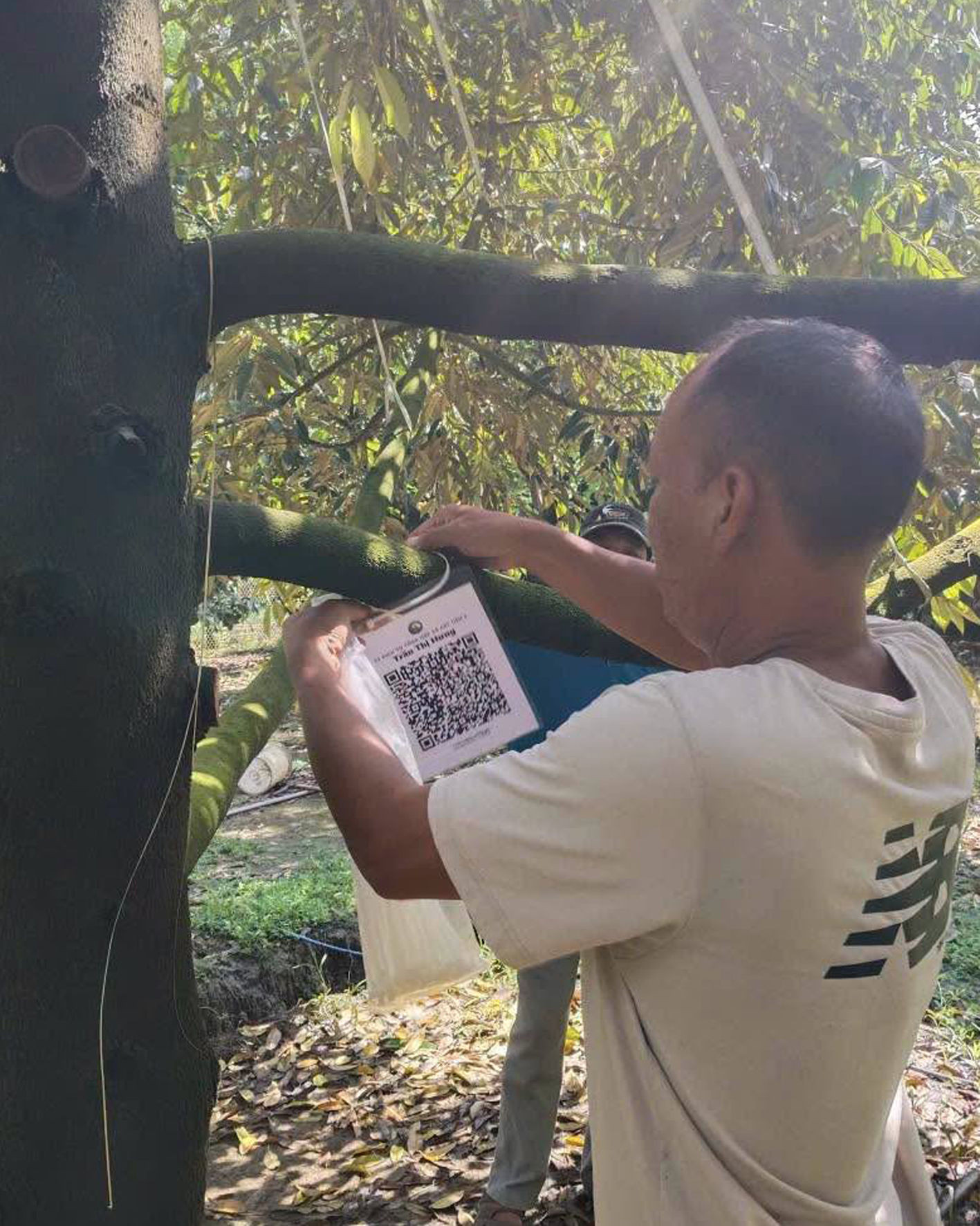
Nguyen Van Thanh, a durian grower in Da Huoai Commune, shared that the quality and flavor of Da Huoai durian are beyond question. However, to reach customers outside Lam Dong Province, all data related to the durian trees must be made public on digital management platforms, as distant customers find it very difficult to verify the specific origin of the product.
That is why Thanh and other durian growers in Da Huoai pay special attention to planting area codes. Once a planting area code is established, customers simply scan the QR code attached to the durian fruit to instantly access all product specifications.
As markets importing Vietnamese agricultural products increasingly tighten technical, quarantine and data management requirements, product traceability is no longer merely a formal technical requirement but has become a supply chain management tool, Thanh said.
In reality, to maintain official agricultural exports, product traceability is a legal solution alongside mandatory technical requirements to ensure product transparency.
Driven by the stringent demands of importing markets, the Lam Dong agricultural sector has proactively built a transparent supply chain and standardized data to enhance its capability to meet the regulatory standards of importing markets.
According to data from the Lam Dong Agricultural Extension Center, the locality currently has 1,611 planting area codes covering a total area of 54,298 hectares.
Among them, 1,094 planting area codes serving export purposes have been approved by importing countries, covering a total area of over 48,016 hectares, while 216 planting area codes covering an area of about 3,444 hectares have been submitted to importing countries for approval.
Le Sy Hoa, Director of the Tan Lac Agricultural and Service Cooperative in Bao Lam 2 Commune, noted that the cooperative's durian planting area spans a total of 21 hectares, with nine farming households participating in production. The durian yield is approximately 30 tons per hectare per year.
According to Hoa, most of the durian area of the Tan Lac Agricultural and Service Cooperative is in the commercial production stage, with tree ages ranging from 5 to 12 years.
The cooperative regularly records production diaries, retains information on agricultural inputs and the location of each plot within the planting area, and monitors production processes and traceability. Hoa added that when information about the planting area, entity, and cultivation process is transparent, it serves as the foundation for the unit to build trust with its partners.
Meanwhile, in Cat Tien 2 Commune, local authorities are also paying special attention to enhancing the transparency of agricultural products by collaborating with MimosaTEK Company to implement a model applying digital technology in durian production. Accordingly, the entire durian care process will be recorded on an IoT technology application, generating data to serve production management and step-by-step enhancing the transparency of durian fruit products in the commune.
From an export technical requirement, product traceability is gradually becoming a vital factor in the agricultural production activities of farmers. Being granted a planting area code is not only a ticket for export but also an affirmation of a controlled production process.