


Enhancing Lam Dong Agricultural Products through Digital Platforms
E-commerce is becoming a new driving force, helping Lam Dong’s agricultural products expand their markets, increase their value, and strengthen their brand identity. Through digital platforms, local products are gradually reaching wider markets and integrating more deeply into the global supply chain.

A “Launchpad” for Agricultural Products to Reach New Heights
According to statistics, more than 50% of Lam Dong’s population regularly engages in online shopping. Business-to-consumer (B2C) e-commerce revenue now accounts for over 10% of the province’s total retail sales and consumer service revenue. Many shops, grocery stores, and businesses have established promotional channels on Facebook, created product websites, or opened online stores.
The province currently has 439 registered e-commerce websites and six e-commerce platforms recognized by the Ministry of Industry and Trade. Between 2021 and 2025, Lam Dong supported more than 2,000 businesses and households in building e-commerce capacity and promoting five key products online: coffee, flowers, macadamia nuts, Laba bananas, and durian. It also helped 30 businesses and cooperatives join or partner with major online marketplaces, including Shopee, Lazada, TikTok Shop, and Alibaba.
Even though e-commerce is still in its infancy in Lam Dong, the region is recognized for its robust telecommunications infrastructure, with 11,500 mobile base transceiver stations (BTS), two-thirds of which are equipped with modern 4G and 5G technology. Mobile broadband is available in 100% of residential areas throughout communes, wards, and special zones. Remarkably, fixed broadband (FTTH fiber optic) has also been extended to all centers of communes and wards. With average download speeds of 40 Mb/s for 4G and up to 150 Mb/s for 5G, both businesses and households in Lam Dong can enjoy internet speeds of up to 1 Gb/s.
A significant achievement in the province's initiatives is the unification of online trading channels. Presently, three local e-commerce platforms (before administrative consolidation) have been merged into one platform at https://sanphamdiaphuong.com.vn, boasting over 850 registered accounts, including more than 420 businesses focused on local specialties and OCOP products, and over 950 listed items. This platform not only supports sales but also incorporates traceability solutions to improve business credibility. Additionally, it is linked to the national e-commerce platform (sanviet.vn), overseen by the Ministry of Industry and Trade, helping Lam Dong’s agricultural products overcome fragmentation and enhance competitiveness in the digital marketplace.
Moreover, the e-commerce site nongsandalatlamdong.vn acts as a digital marketing channel for the agricultural industry, featuring more than 900 businesses and over 2,000 products, with an average of 90,000 visits each month in 2025. E-commerce has evolved into a significant resource that enables Lam Dong’s agricultural products to integrate into the global value chain. By leveraging cross-border platforms, local specialties can instantly reach customers worldwide with a single click. Streamlining supply chains through online transactions minimizes product spoilage, conserves transportation energy, and supports a sustainable circular economy.
Opportunities to Join the Global Value Chain
Online trading allows businesses, cooperatives, and individuals to significantly reduce costs associated with physical premises and traditional labor, while also promoting the development of digital data and storage systems. E-commerce facilitates the direct transfer of products from producers to consumers, minimizing the need for intermediaries that can lead to waste and harm. It creates a modern business environment that connects everything and removes geographical barriers, enabling buyers and sellers to trade goods with clear origins quickly and effectively through technology.
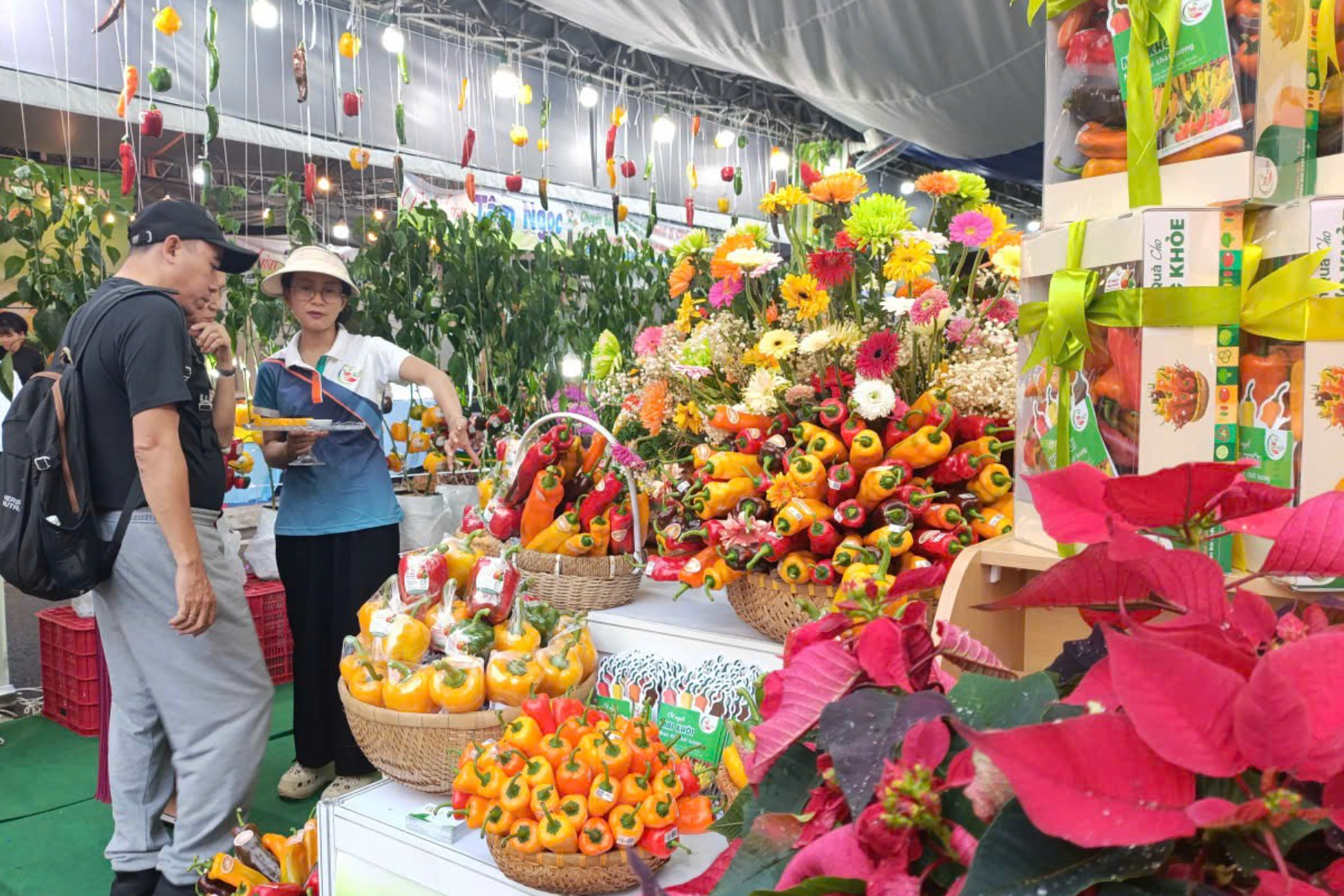
According to Mr. Tran Huy Duong, Chairman of the Members’ Council of LangBiang Farm Co., Ltd.: “E-commerce is a trend that brings enormous benefits which businesses, producers, and service providers cannot ignore—especially for Lam Dong’s agricultural products. Selling online today is not simply about having a smartphone or knowing how to transfer money via apps. Sellers must understand what consumers need and how they can meet those needs effectively.”
According to data from the agriculture and industry sectors, the province currently has 963 export crop area codes and 338 packaging facility codes. Numerous OCOP products have received 3- to 5-star certification, primarily in the categories of fresh fruits and vegetables, tea, coffee, macadamia nuts, and flowers. This provides a foundation for active participation in cross-border e-commerce. Several businesses are using promotional channels on social media platforms like Facebook and TikTok not just to showcase their products but also to share stories about their production processes and to enhance brand identity, fostering trust and strong bonds with customers. Furthermore, many are investing in digital infrastructure to implement modern business models that meet customer expectations.
Supporting Businesses in E-commerce Development
With the rise of e-commerce, tax management has become increasingly challenging in ensuring fairness and preventing revenue loss. As e-commerce continues to expand at an annual rate exceeding 20%, Lam Dong’s tax base is also growing. A 2025 report indicates that tax officials reviewed 4,524 cases. Of these, 253 businesses accounted for VND 345.2 billion in tax obligations, of which VND 308.5 billion had been collected. The remaining 4,274 cases accounted for VND 33.6 billion in tax liabilities, with nearly VND 31.7 billion collected.
Since July 2025, the “withholding at source” policy has demonstrated its effectiveness. In Lam Dong, two companies have received withholding codes, resulting in tax contributions of over VND 8.7 billion, while nearly 3,000 registrations have been documented with total tax payments surpassing VND 21.1 billion. The tax authorities have also enhanced data reconciliation with delivery companies such as Viettel Post and express delivery service providers to oversee revenue from individuals involved in livestream selling and “agricultural KOLs.”

Looking toward 2030, the province's goal is for e-commerce retail revenue to exceed 20% of overall retail sales, ensuring that all transactions on platforms are paired with e-invoices and establishing a foundation for a transparent and sustainable digital economy. To reach this objective, Lam Dong aims to have 75% of internet users shopping online, 60% of small and medium-sized enterprises operating on e-commerce platforms, and 80% of transactions conducted without cash. Additionally, the province will launch initiatives to help businesses enter and grow in e-commerce.
Ms. Vo Thi Hoang Yen, Deputy Director of the Provincial Investment, Trade, and Tourism Promotion Center, said:
“In 2026, the center will host a variety of trade promotion initiatives that align with the province’s developmental goals. Companies can sign up to take part in exhibitions and product displays showcasing OCOP products, local specialties, and high-tech agricultural goods, both nationally and internationally, along with programs aimed at bringing Vietnamese products to mountainous, rural, and island regions.”
In terms of e-commerce, the center encourages businesses and cooperatives to engage in online trade promotion activities such as conferences and webinars, as well as participate in virtual trade connections and digital marketing initiatives through short videos or e-books shared on websites, social media platforms, or other organized online formats by ministries, sectors, and local authorities. These initiatives aim to enhance the visibility of Lam Dong products in both domestic and international markets.
With its strong digital infrastructure and growing distribution network, Lam Dong is dedicated to creating a cohesive e-commerce ecosystem. This approach not only helps individuals engage in professional online business but also fosters collaborative benefits, accelerating digital economic growth while ensuring environmental sustainability.