


EUDR poses major test for Lam Dong coffee sector
With the largest coffee-growing area in Viet Nam and an annual output exceeding 1 million tonnes, Lam Dong Province has long affirmed its position through scale and a broad export footprint. However, the European Union’s deforestation regulation (EUDR) is emerging as a major challenge for the province’s coffee industry as it seeks to maintain its competitiveness in international markets.
From scale advantage to new compliance pressure
Under the EUDR requirements, coffee imported into the EU must be proven deforestation-free as of December 31, 2020, comply with land legality requirements, and be fully traceable down to individual plots of land. Coffee exports, therefore, must not only meet quality and safety standards but must also be accompanied by complete and verifiable documentation from farm to port.
Yet Lam Dong currently has only 435 hectares of coffee granted planting-area codes, a very modest figure compared with more than 328,000 hectares under cultivation across the province.
Beyond the issue of planting-area codes, a bigger challenge lies in building and harmonizing forest databases as of December 31, 2020—the most critical legal benchmark for proving compliance with deforestation-free requirements. The province must review and standardize forest maps based on newly adjusted administrative boundaries, while also securing high-quality satellite imagery for verification. This is a complex and costly task, requiring coordinated efforts from multiple sectors as well as support from central authorities and international organizations.
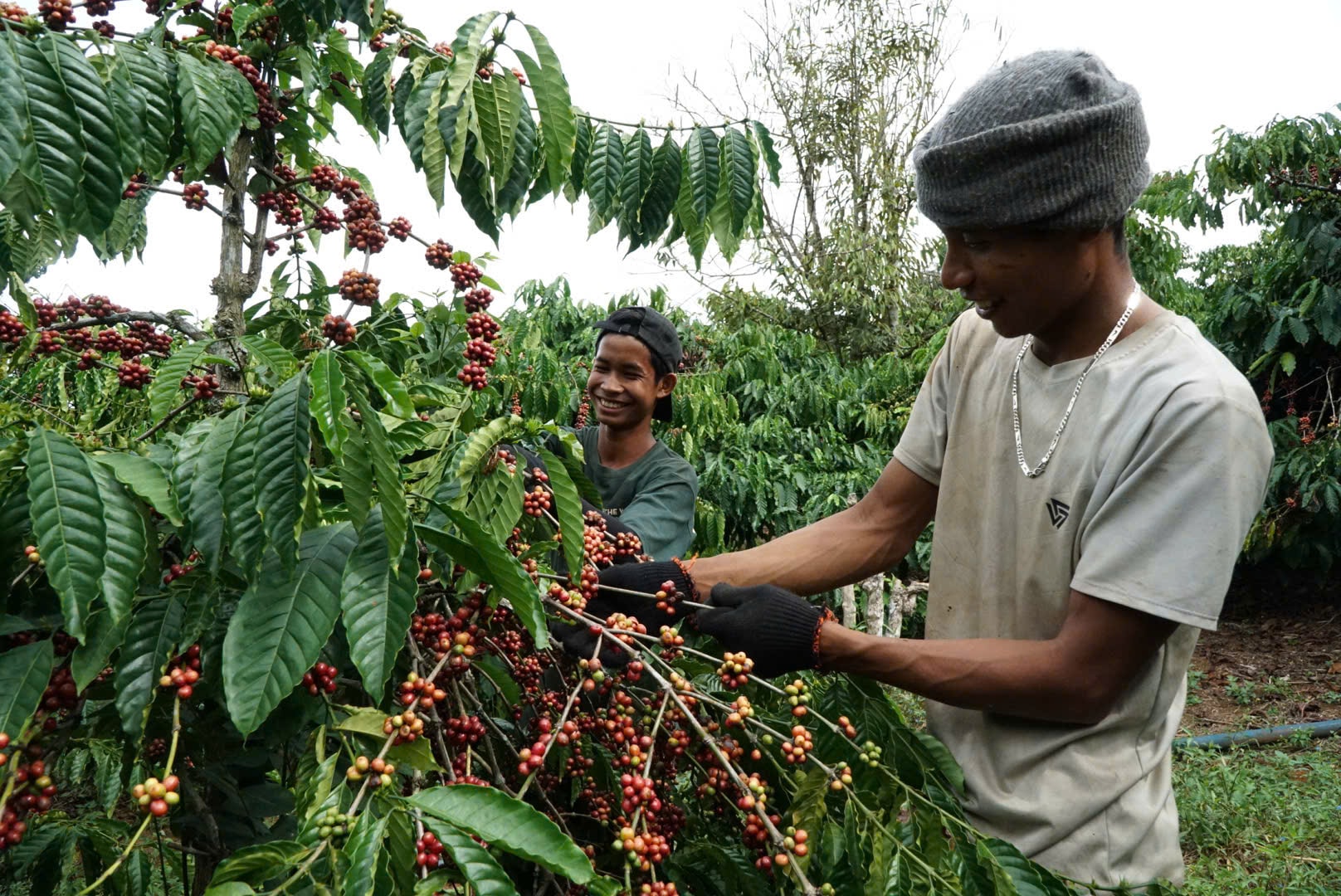
At the same time, Lam Dong’s coffee production relies heavily on around 220,000 farming households, most of them smallholders. Collecting GPS data, mapping plot polygons, guiding farmers through declarations, and uploading information to traceability systems represent an enormous workload—one that cannot be completed through administrative efforts alone.
From a business perspective, Trinh Thi Thanh, director of a coffee purchasing and export-import company in Nam Gia Nghia Ward, said that immediately after the EU’s deforestation regulation was introduced, her company proactively reviewed its entire raw material areas and implemented multiple measures to meet new European market requirements.
However, she noted that production realities pose significant challenges, as most coffee farms are small-scale and intercropped with various other crops. This increases the time and costs involved in registering planting-area codes and establishing traceability systems. She emphasized that businesses urgently need robust support from state management agencies, particularly regarding unified guidance on procedures, forest data, and EUDR compliance verification mechanisms, to mitigate risks and financial burdens for both enterprises and farmers.
A test beyond farmers alone
Lam Dong has already established a solid foundation for sustainable coffee production. Nearly 119,000 hectares of coffee in the province are certified under international standards such as VietGAP, 4C, UTZ, Rainforest Alliance, and organic protocols. In addition, 65 value chains have been formed, involving more than 29,000 farming households and numerous enterprises and cooperatives. Intercropping models combining coffee with fruit trees and industrial crops, covering approximately 60,000 hectares, have boosted incomes while advancing ecological goals and alleviating pressure on land and forest resources.
However, sustainability certifications and value-chain linkages represent only the baseline requirement. The EUDR demands a higher level of transparency, greater data granularity, and much stricter legal accountability. If enterprises fail to build integrated traceability systems, if local authorities lack accurate land and forest status data, and if farmers are not provided with clear guidance, the risk of exclusion from the EU market becomes substantial.
Under the roadmap, large enterprises must comply with EUDR from December 31, 2025, while small and micro enterprises have until June 30, 2026.
Conversely, EUDR could become a powerful catalyst for Lam Dong’s coffee sector to undergo deeper restructuring. Well-organized raw material areas with comprehensive data and strong environmental compliance will gain clear advantages in price negotiations and market access. State agencies are expected to establish legal frameworks and baseline data, enterprises to invest proactively in traceability systems and work closely with farmers, and coffee growers themselves to change production habits by improving record-keeping and enhancing information transparency.