


Expanding Reishi Mushroom Cultivation Beneath Bamboo Forest Canopies
At 75, Le Minh Hoang and Nguyen Thi Sang are marking a breakthrough year as their model of cultivating reishi mushrooms beneath four-season bamboo forests in B’Nor Hamlet, Ta Dung Commune, Lam Dong Province delivers strong economic results. The initiative not only secures stable income for their family but also opens prospects for building large-scale medicinal raw-material zones linked to processing, domestic consumption and export.
From setbacks to a VietGAP bamboo success story
Nearly a decade ago, the couple traveled widely to source suitable bamboo varieties before launching large-scale planting. Early stages were challenging: unfavorable weather and technical gaps caused losses of nearly VND 7 billion within the first year alone. Undeterred, they refined their cultivation methods,, stabilized growth conditions and gradually built a value-chain approach to production.
Today, more than 40 hectares of bamboo are cultivated under VietGAP standards at a density of around 1,000 clumps per hectare. Bamboo shoots can be harvested after six months, yielding about 60 tons per hectare. Their brand, “Ba Sang Four-Season Bamboo Shoots,” has received exclusive trademark protection from the Intellectual Property Office of Vietnam through 2033 and now extends across a production network exceeding 180 hectares nationwide, generating average incomes of VND 400–500 million per hectare annually.
A “dual-income” model under the bamboo canopy
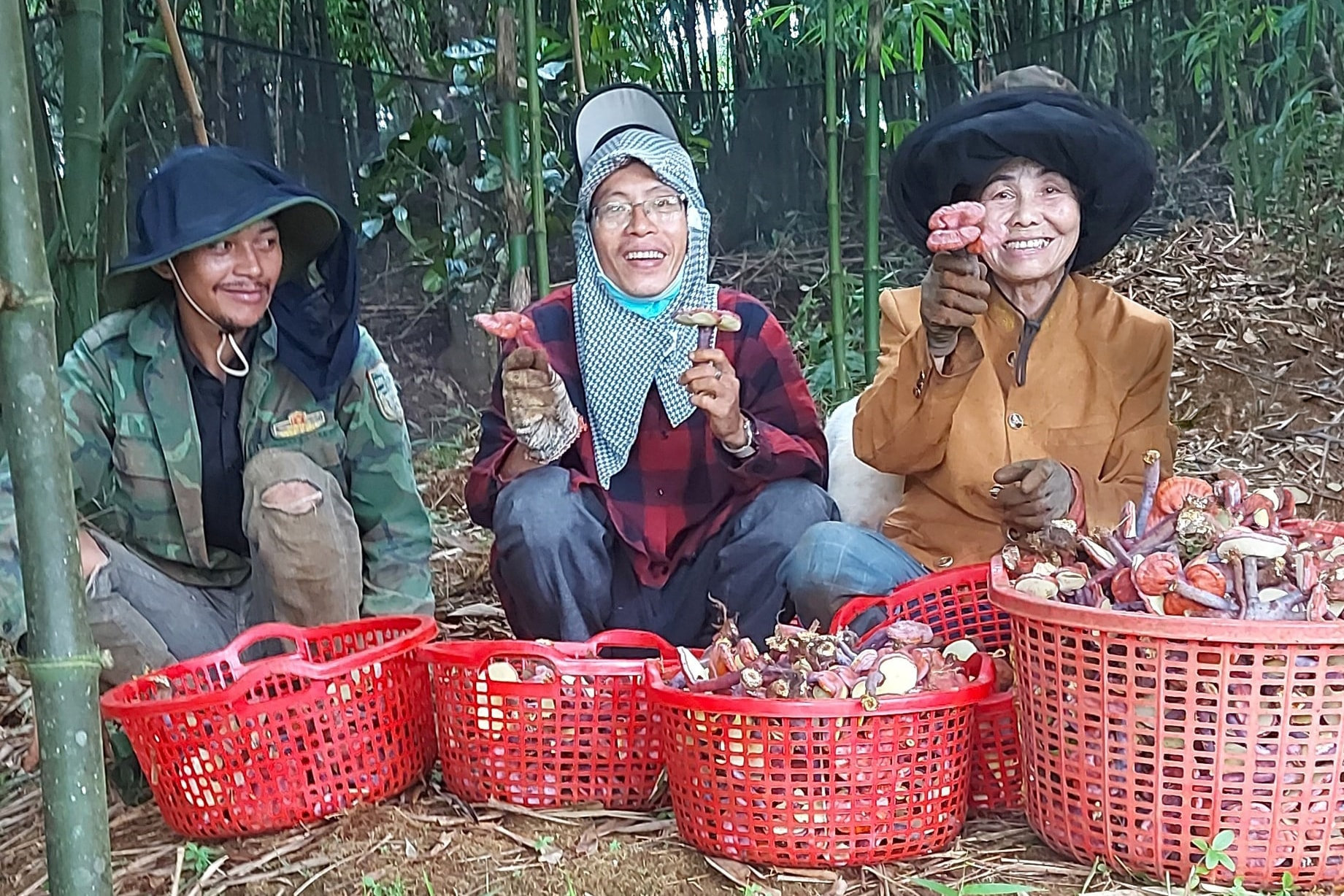
With the bamboo canopy established, the family began piloting reishi mushroom cultivation in February 2025. An initial 500-square-meter area with 1,200 substrate bags produced two harvests totaling about 200 kilograms of dried mushrooms by September, generating roughly VND 400 million.
Through hands-on experimentation, they improved efficiency by placing substrates directly on the ground, covering them with dry straw and pruning bamboo branches to enhance airflow. The adjustments pushed harvest success rates above 95%.
By early 2026, the model expanded to one hectare with 17,000 substrate bags beneath VietGAP-certified bamboo forests. Harvest cycles occur every three months, with 45 bags producing around 3 kilograms of fresh mushrooms, equivalent to 1 kilogram of dried product sold at VND 2–3 million per kilogram.
Beyond their own farm, the couple supports four local households by providing land access, advance capital and technical guidance. Farmer Phung Hoc Duong said his family’s initial trial of 500 substrate bags achieved two successful harvests after more than 70 days, and the model has since expanded to one hectare with staggered harvests every 10 days.
Toward a medicinal agriculture value chain
Looking ahead, Hoang and Sang plan to expand reishi cultivation to about 20 hectares beneath bamboo forests in B’Nor Hamlet, integrating production with processing to increase product value.
According to Bui Xuan Tinh, Chairman of the Ta Dung Commune Farmers’ Association, the model creates a sustainable “dual-income” structure — combining bamboo shoots with high-value medicinal mushrooms — while supporting environmental protection. The association will continue promoting replication of the model to help local farmers diversify livelihoods and strengthen value-chain linkages.