


Integrating AI into education - A gradual transformation
From traditional classrooms with chalk and blackboards, schools across Lam Dong are gradually transitioning into digital learning environments, where Artificial Intelligence (AI) is emerging as a powerful tool to support teaching and learning.
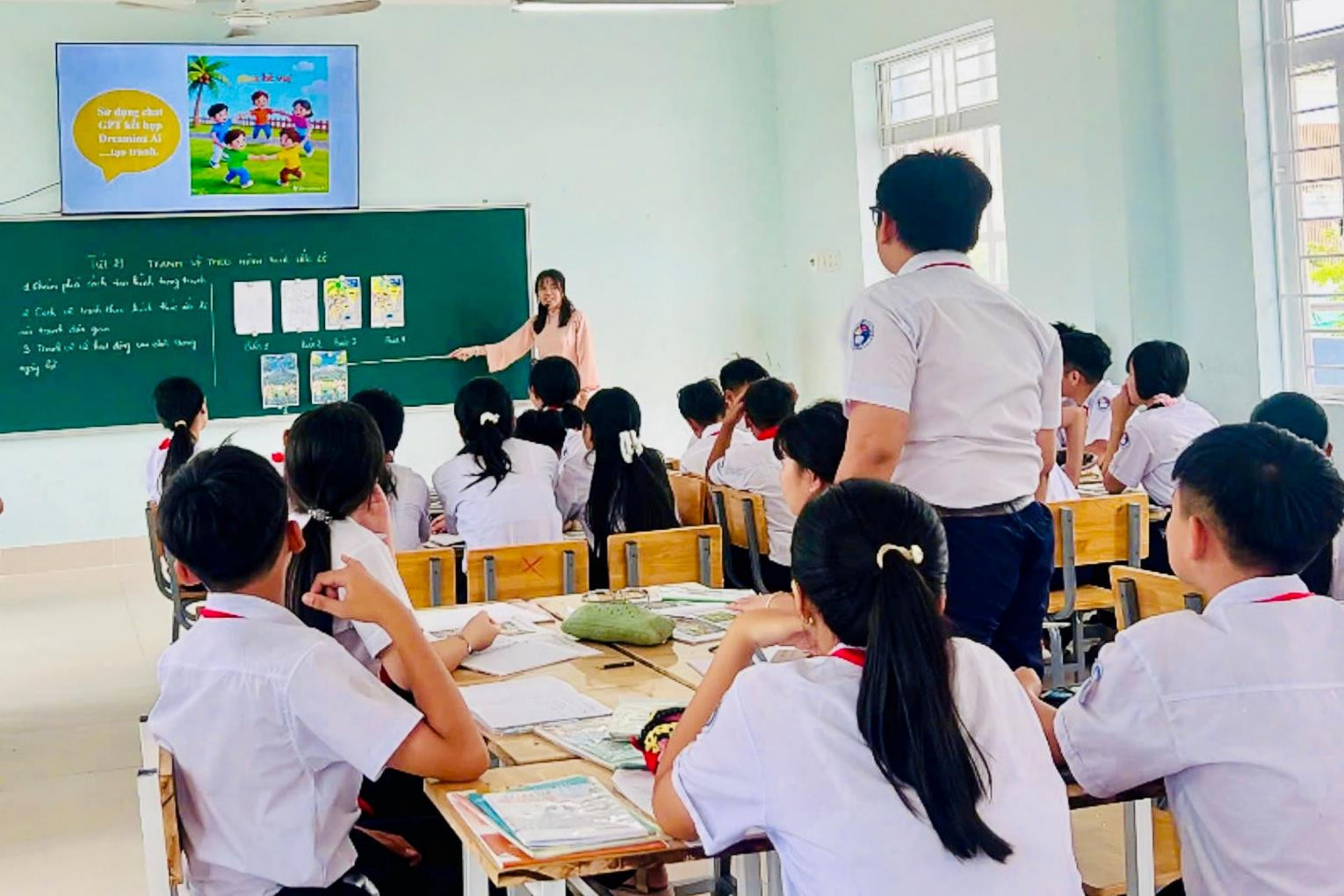
The AI classroom
Phuoc Hoi 1 Secondary School is among the institutions selected by the provincial Department of Education and Training to pilot AI integration in teaching. The school has organized AI-integrated teaching events across different subject groups, creating opportunities for teachers to exchange ideas and share experiences.
In a literature class, instead of simply listening and taking notes, students now interact with visuals, guided questions, and scenarios designed with AI support. The classroom becomes more dynamic, students more proactive, and teachers gain new tools to enhance their lessons. This reflects how AI is quietly entering schools while making a meaningful impact.
Nguyen Thi Kim Yen, a literature teacher, noted that AI is effective in lesson planning and assessment. However, she emphasized that human judgment remains crucial: “We should not overuse or depend entirely on AI. Teachers and students need to evaluate and verify information to use technology responsibly and effectively.”
From a management perspective, Principal Nguyen Minh Bao Phuc shared that with all classrooms equipped with TVs and internet access, AI integration has been smooth. Teachers are actively adopting new methods, while students show greater enthusiasm for engaging, visual lessons. The school has already applied AI comprehensively in IT classes and is gradually integrating it into other subjects, with plans for wider implementation in the next academic year.
Meanwhile, several high schools in the province have also begun incorporating AI into teaching. Through lesson observations and teaching demonstrations, educators are learning how to use AI tools effectively for lesson design, classroom activities, and student assessment. As a result, many lessons have become more interactive and student-centered.
Developing comprehensive competencies
In the 2025–2026 academic year, Lam Dong’s education sector launched a pilot plan to introduce AI into general education. Rather than making AI a standalone subject immediately, it is being integrated flexibly into existing subjects—especially IT—as well as extracurricular activities, clubs, and thematic sessions. This approach allows schools to experiment gradually without overloading the current curriculum, while still giving students early exposure to new technologies.
According to the province’s educational orientation, AI education is not just about technological knowledge. It aims to develop students’ overall competencies, including digital thinking, problem-solving skills, creativity, and responsibility in the digital environment. The curriculum is built around key pillars such as AI ethics, technical understanding, practical applications, and human-centered thinking.
However, the journey is not without challenges. Differences in infrastructure—especially in disadvantaged areas—remain a significant barrier. Additionally, not all teachers are immediately ready to adapt to new methods.
To ensure effective implementation, the education sector has identified three key factors: technological infrastructure, teacher capacity, and collaboration with organizations and businesses. Among these, teacher training is considered the “key” to transitioning from traditional teaching methods to a modern educational environment.
The pilot of AI education is expected to lay the foundation for Lam Dong to refine its model and expand it across the entire system. More importantly, it prepares students not only to use technology, but also to master it in the future.