


Lam Dong Drives Agricultural Breakthrough with High-Tech, Green Growth
After years of restructuring toward high-tech, green and circular agriculture, Lam Dong Province is accelerating data-driven farming, integrated value chains and deep processing to sustainably enhance agricultural value and exports.
.jpg)
Data-Driven Farming Replaces Intuition
Across more than 30 hectares of passion fruit and vegetable production areas, Minh Duc Agriculture and Trade Cooperative (HTX Minh Duc) in Duc Trong Commune no longer starts a crop season with mass planting. The first step is soil, water and nutrient analysis to select the most suitable crops. Every production decision is based on data rather than intuition, and many cooperative members are now familiar with using electronic farming logs.
According to Luu Lap Duc, Director of Minh Duc Cooperative, the unit is applying electronic systems to automate irrigation and nutrient management for passion fruit and short-term vegetables. The goal is not only to increase productivity and reduce costs, but also to help farmers proactively plan production, mitigate risks and enhance product value. Furthermore, Minh Duc Cooperative is stepping up communications and product promotion on digital platforms, gradually building a transparent brand with clear origin traceability.
Duc Trong Commune currently has more than 5,300 hectares of high-tech vegetable and flower cultivation, generating an average production value of VND 400–450 million per hectare per year, with some models exceeding VND 1 billion per hectare. More than 2,186 farming households—accounting for over 41% of agricultural producers—have joined production and consumption linkage chains.
Toward Green, Modern and Sustainable Agriculture
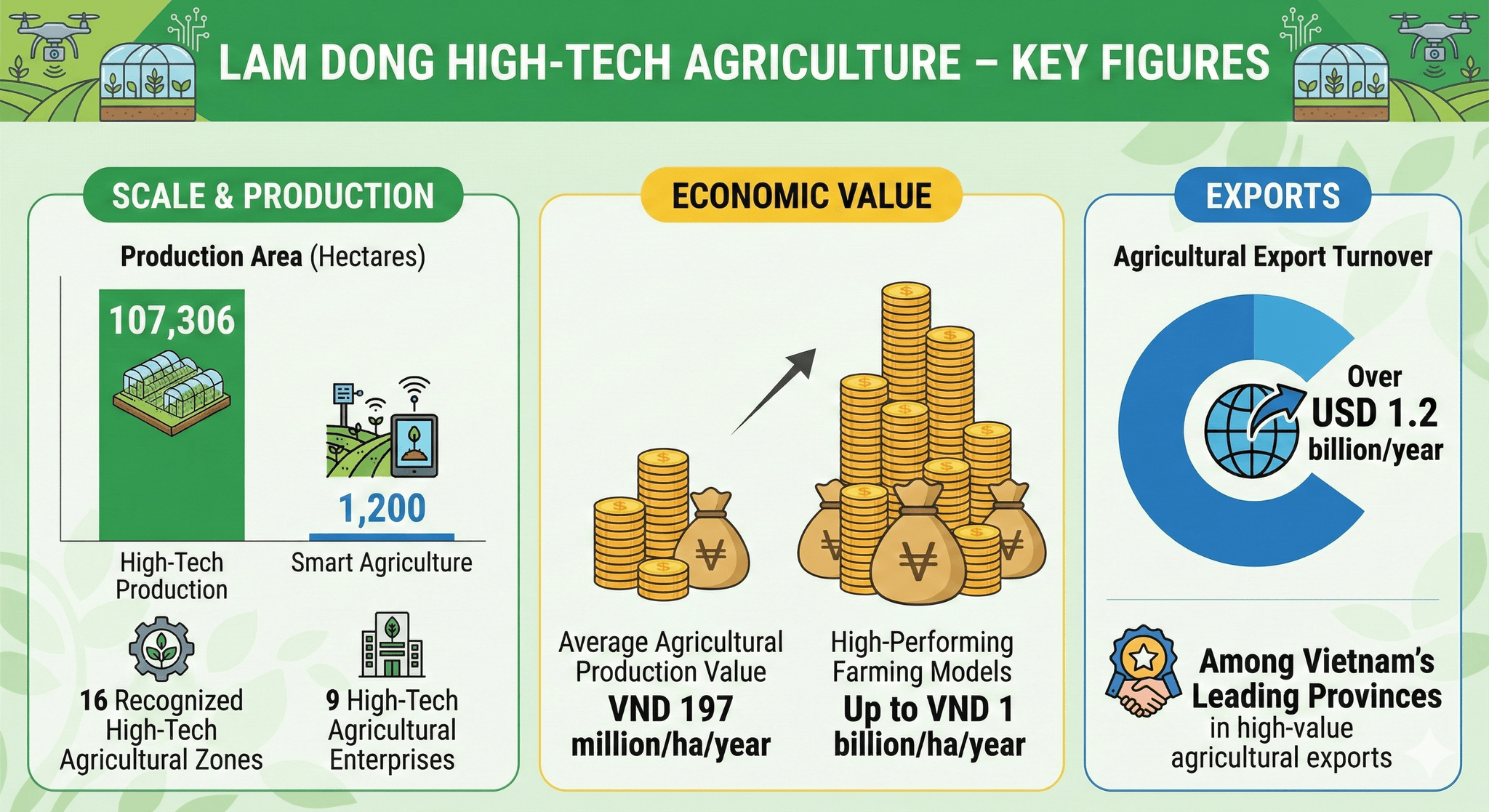
Lam Dong now has 107,306 hectares meeting high-tech agriculture criteria, including 1,200 hectares of smart agriculture. The province has recognized 16 high-tech agricultural zones and nine high-tech agricultural enterprises. Average agricultural production value has reached nearly VND 197 million per hectare per year.
Agricultural export turnover has been maintained at over USD 1.2 billion annually, placing Lam Dong among the country’s leading localities in high-value agricultural exports. These results reflect the province’s long-term agricultural restructuring toward green growth, high technology and a circular economy.
Under orientations toward 2030, Lam Dong aims to expand high-tech agricultural production to more than 150,000 hectares, while reorganizing production around closed value chains—from production and processing to consumption. By 2030, the province targets 70% of key agricultural output to be deeply processed.
This goal signals a strategic shift from "quantity-driven" to "value-driven" growth, with processing and markets serving as key pillars rather than merely expanding cultivation areas. Deep processing is viewed as a critical bottleneck to increasing added value and reducing dependence on raw commodity markets.
Crop and livestock restructuring continues to be promoted toward high-tech, organic and ecological agriculture. Models featuring water-saving irrigation, automation, smart sensors and digital technologies are being expanded, helping reduce irrigation water use by 20–30% and agricultural inputs by 25%.
Lam Dong’s agricultural products are gradually forming raw material zones that meet increasingly stringent export market requirements for environmental standards and traceability. A key direction being prioritized is the development of green OCOP and low-carbon agricultural products, aligned with environmental standards and sustainable value chains. This is seen as a “passport” for local agricultural products to penetrate premium markets, where value lies not only in the product itself, but in how it is produced.
High-tech agriculture in Lam Dong is creating tangible breakthroughs, enhancing agricultural value while shaping a green and modern agricultural model—one where high technology is not confined to large-scale projects, but spreads to farming households, ensuring growth goes hand in hand with resource conservation and environmental protection.
During the 2020–2025 period, agriculture continued to affirm its role as a pillar of the provincial economy, maintaining an average growth rate of 4.75% per year and contributing approximately 34% of Lam Dong’s GRDP.