


Macadamia Farming: Adding Value at the Source in Phuc Tho Lam Ha Commune
From committing to macadamia cultivation to investing in processing and developing farmer linkages, growers in Phuc Tho Lam Ha Commune are working to retain and enhance agricultural value right at the production area.
Staying with Macadamia
Phuc Tho Lam Ha benefits from favorable natural conditions for perennial crops, with macadamia increasingly emerging as a key economic tree. By 2025, the commune had around 815 hectares of macadamia, mostly intercropped with coffee, producing an average of about 2,445 tonnes of fresh nuts annually.
In Doan Ket Hamlet, Mau Hang Business Household is among the early participants deeply engaged in the macadamia value chain. Amid price fluctuations affecting many agricultural products, Phan Thi Hang, the product owner, chose to remain committed to macadamia cultivation while moving toward processing to retain added value.
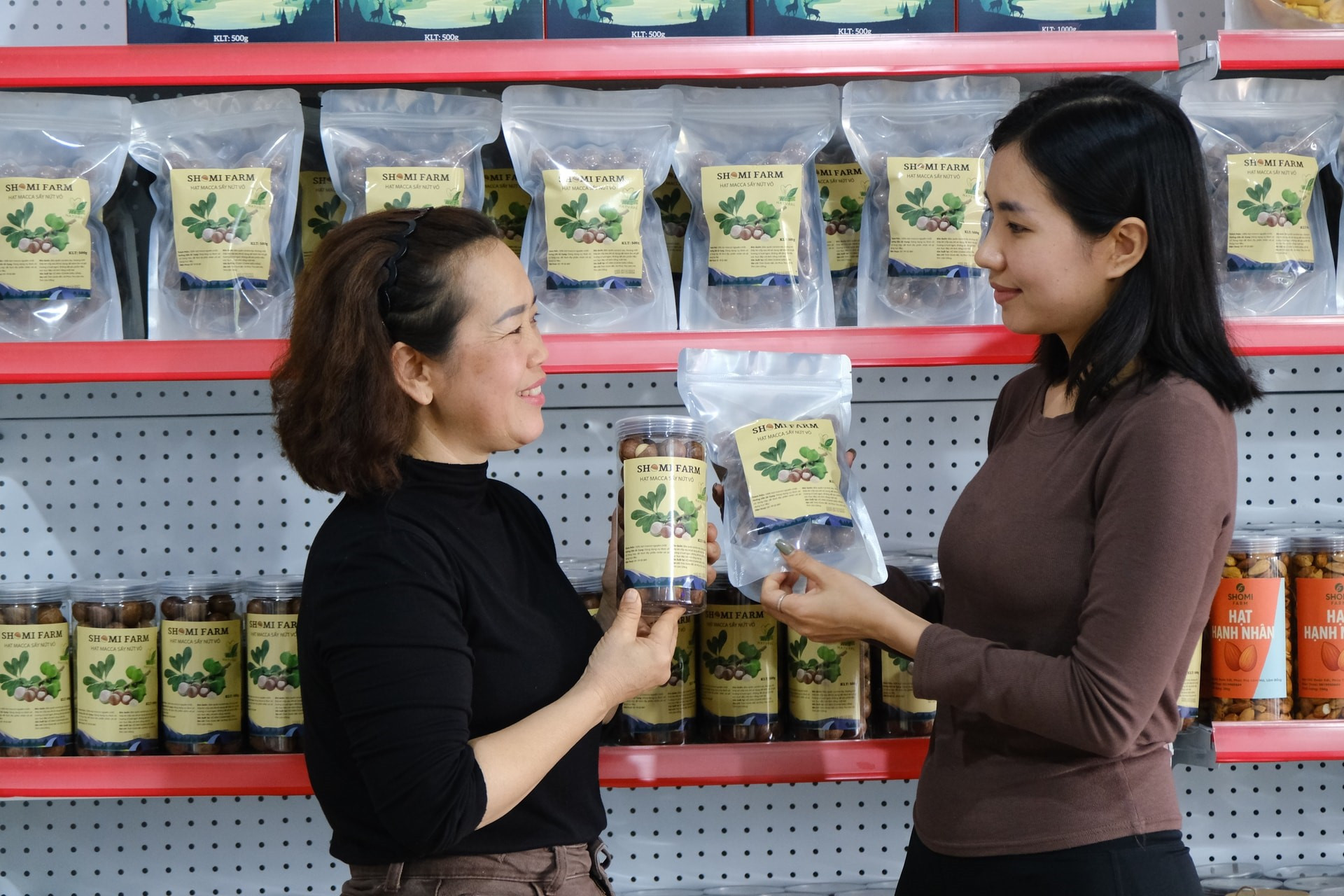
Following this decision, the facility invested in a drying system with a capacity of 50 kilograms per batch in 2023, gradually completing its production process. By 2024, cracked-shell dried macadamia nuts under the SHOMIFARM brand had taken shape. In 2025, the processing area was expanded to 76 square meters, meeting food safety standards and legal requirements.
The SHOMIFARM cracked-shell dried macadamia product has since been certified as a 3-star OCOP product, marking a significant transition from small-scale production to standardized goods with market expansion potential.
Alongside processing investment, the business has actively built a stable raw material zone by linking with more than 18 macadamia-growing households in the commune. Fresh macadamia nuts are purchased directly under contracts, with prices ranging from VND 95,000 to 100,000 per kilogram.
On average, around 22 tonnes of fresh nuts are processed annually, including approximately 8 tonnes produced by the family itself. The remaining volume comes from partner households, covering nearly 7 hectares of productive orchards. All supplying gardens are over 10 years old, mainly planted with OC and QN1 varieties.
Among the partner farmers, Vo Thi Ngan, who owns a two-hectare macadamia orchard over 12 years old, said her family has been selling fresh nuts to Mau Hang for the past two years. “Every three months, we supply about three tonnes of fresh macadamia nuts through direct purchasing, which ensures stable output and makes orchard management easier,” she said.
According to Phan Thi Hang, purchasing by individual orchards allows the facility to control raw material quality from the outset while giving farmers peace of mind.
We work directly with growers to agree on cultivation and harvesting practices so that the processed products are consistent and maintain credibility.
Ms Phan Thi Hang, owner of Mau Hang business household, Phuc Tho Lam Ha Commune
Preserving the Value of Macadamia Nuts
From fresh nuts to finished products, the entire process is tightly controlled within a closed production chain. After procurement, immature and damaged nuts are removed, shells are separated on the same day, followed by washing, air-drying and size grading. Subsequent stages include moisture-reduction drying, aroma-enhancing drying, cooling, shell cracking, light inspection and final sorting before packaging.
Thanks to this process, Mau Hang’s cracked-shell dried macadamia nuts retain their natural flavor, uniform color and food safety standards. Current production capacity stands at about 10 tonnes of finished products per year.
The products are distributed through convenience stores, health-conscious consumer groups, supplied as raw materials to small processing facilities, and retailed via social media platforms and e-commerce channels.
Ms Phan Thi Hang said that participating in processing enables farmers to be more proactive in pricing and product promotion. Each pack of macadamia nuts carries a story about its growing area, production process and the cooperative network among local households.
According to Tran Duc Them, Chairman of the People’s Committee of Phuc Tho Lam Ha Commune, household investment in processing, branding and participation in the OCOP program has contributed to increasing the value of local agricultural products. Models that link production with raw material zones, ensure standardized processes and achieve product certification will provide a foundation for market expansion, higher incomes and more stable value chains in the years ahead.