


Organic shift boosts Lam Dong coffee exports
Situated about 1,000 meters above sea level, Lam Dong’s central coffee-growing region is expanding organic cultivation to strengthen exports to international markets such as India, the U.S, Europe, Asia, and the Middle East.
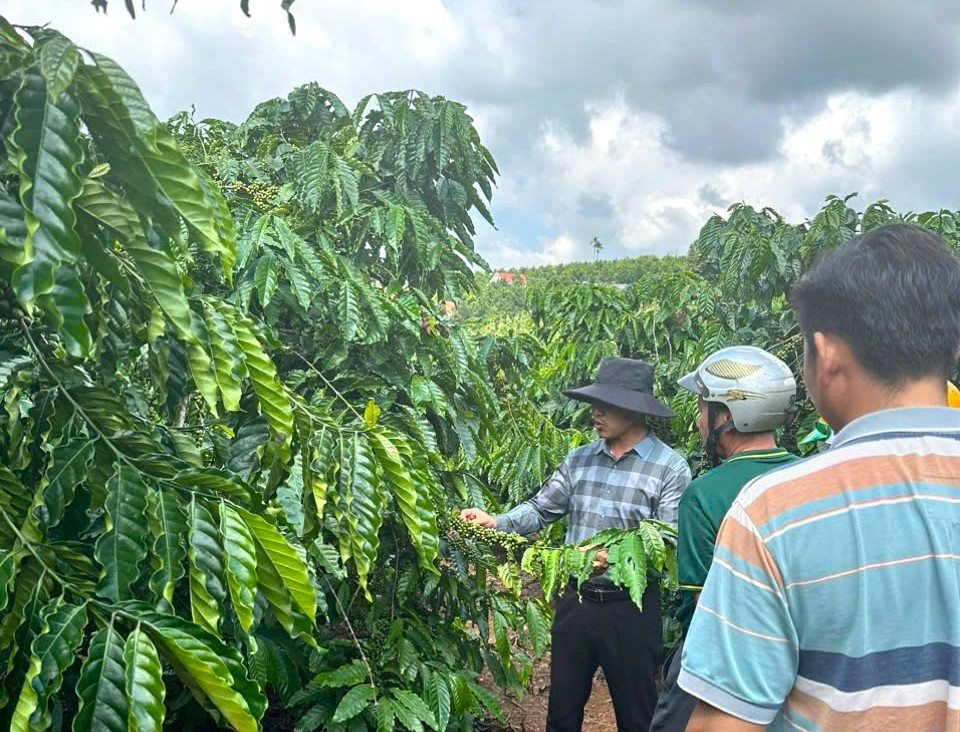
Upgrading organic cultivation techniques
Following rains in early May, Nguyen Anh Duc, a coffee farmer in Tan Trung Hamlet, Tan Ha Commune, began pruning old branches, trimming canopies and applying organic fertilizer around the roots of his coffee trees to prepare for the next harvest season.
Duc and his family are currently cultivating more than 1.5 hectares of nearly 15-year-old coffee trees under certified organic standards. Their farms also integrate shade trees and additional crops such as macadamia, pepper and fruit trees to improve biodiversity and increase income.
“Our coffee farms have been certified under Vietnam’s organic farming standards for more than four years,” Duc said. “Since joining Bac Tan Ha Group Cooperative, we have continued improving cultivation techniques to meet higher export requirements while increasing both productivity and quality.”
Under the organic farming model, the family produces biological fertilizers from livestock waste and crop byproducts, uses clean groundwater filtered on-site and applies biological pest-control products instead of chemical pesticides.
As a result, the family’s organic coffee yield in the 2025-2026 crop season increased by nearly one ton per hectare compared to conventional farming methods used in previous years.
Nguyen Dinh Quy, Director of Bac Tan Ha Group Cooperative, said the cooperative currently works with around 200 farming households cultivating 350 hectares of organic coffee across Tan Ha, Phuc Tho, Phu Son and Dinh Van communes in Lam Dong Province.
The cooperative provides technical guidance, advances biological fertilizers and purchases all harvested coffee at prices roughly 10% higher than the market rates.
Indian partnership opens new export opportunities
Over the past three months, Bac Tan Ha Group Cooperative has processed and applied more than 10,000 liters of organic fertilizer for irrigation and spraying, helping coffee trees develop stronger root systems and larger fruit sizes while reducing input costs by an estimated 30%.
According to Nguyen Dinh Quy, around 100 hectares of coffee farms have completed or are completing certification procedures for organic production, while the remaining 250 hectares are gradually transitioning away from chemical inputs.
In collaboration with Binh Loc Cooperative in Bao Loc Ward 2, the cooperative has also introduced soil treatment technologies to remove inorganic residues from coffee farms. Over the next one to three years, the entire 250-hectare production area is expected to meet international organic export standards.
The partnership has recently expanded through cooperation with India’s Planttrich Group, which has directly supported local farmers with technical guidance on organic coffee cultivation and export standards.
Under the partnership model, coffee harvested by member farmers is collected and supplied to Planttrich before being distributed to markets in 25 countries worldwide.
Bijumonkurien, a representative of Planttrich Group, said the company remains committed to supporting farmers in preserving soil fertility and ensuring that exported coffee products meet strict organic requirements set by importing countries. The collaboration, he added, aims to improve both sustainability and long-term income for local coffee growers.