


Phuoc Loc Communal House and Whale Temple: A Distinctive Coastal Cultural Heritage Site
Phuoc Loc Communal House and Whale Temple were recognized as a National Architectural and Artistic Heritage Site by the Ministry of Culture, Sports and Tourism in 2012. Historical records indicate that the site originated in the late 19th century, situated in the old Phuoc Loc coastal area, during the period of settlement and expansion into the new lands of La Gi, Ham Tan, Tan Ly and Tam Tan.
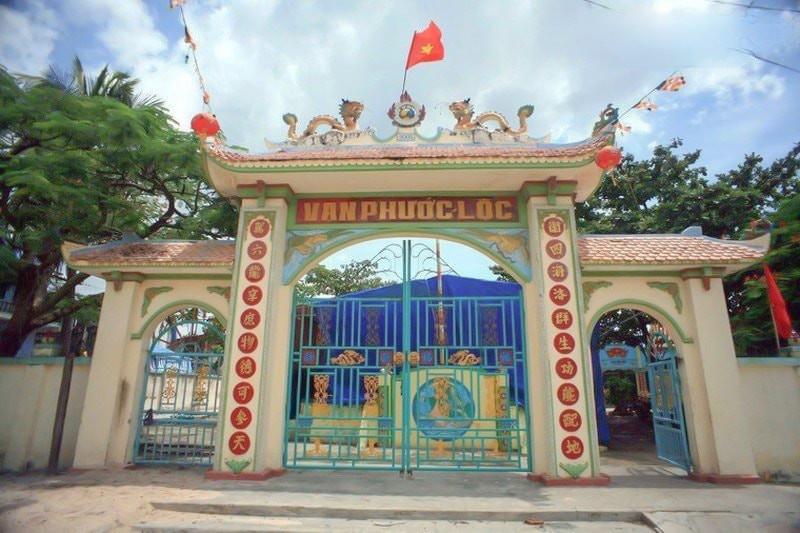
A Historic Landmark on the Coastal Route
According to Dai Nam Nhat Thong Chi (Volume XII), along the official route of imperial courier stations recorded in 1845 under the Nguyen Dynasty, there were 12 stations from North to South. Among them was “Thuan Phuoc Station in Phuoc Loc Ward, Tuy Ly District,” located south of Thuan Trinh Station (near the Ma Ly River–Tam Tan area) in Tan Hoang Hamlet, Tuy Ly District, along the coastal route. Thuan Phuoc Station lay on the main imperial road between Thuan Ly Station (in present-day Phan Thiet) and the two stations of Thuan Phuong and Thuan Bien (bordering the former Bien Hoa region).
Phuoc Loc was a vast area on the right bank of the La Gi estuary, home to a military outpost. With both marine and forest resources, fertile land for cultivation and rich fishing grounds, it quickly attracted settlers, especially migrants from central provinces. Inscriptions at the temple still bear the Han-Nom characters “Phuc Loc,” meaning “blessings and prosperity.”
Through periods of upheaval, from early settlement to the resistance against French colonial rule, both the communal house and whale temple suffered severe destruction under scorched-earth policies. Only remnants of wooden beams and door frames survived. Yet, the coastal villagers maintained a resilient, pure faith in the divine protection that guarded them against storms and lean fishing seasons. When the seas turned rough, locals pivoted to farming. Over time, this formed a unique, harmonious lifestyle imbued with humanity and the resilient spirit of Phuoc Loc’s seafaring community.
Museum assessments later affirmed that the site holds dual functions: it worships both the village guardian deity and the Whale God, hence its compound name Phuoc Loc Communal House – Whale Temple.
Cultural Legacy and Sacred Traditions
The preserved parallel sentences convey messages to future generations about pride of the land built by their ancestors. They include verses such as:
“Blessed land brings peace and prosperity,
Divine grace endures like the eternal waves.”
At the Guardian Deity shrine, another verse reads:
“Good fortune nurtures harmony and joy,
A sacred land where blessings thrive.”
In earlier times, despite the many hardships of coastal life and the rudimentary boats and fishing gear available to them, fishermen lived with deep bonds of solidarity, both onshore and at sea, and upheld strong communal values. Their faith in the supernatural power of the ocean was expressed through the whale temple, where sacred whale bones were enshrined, symbolizing both divine protection and gratitude toward the ancestors who first settled and cultivated the land.
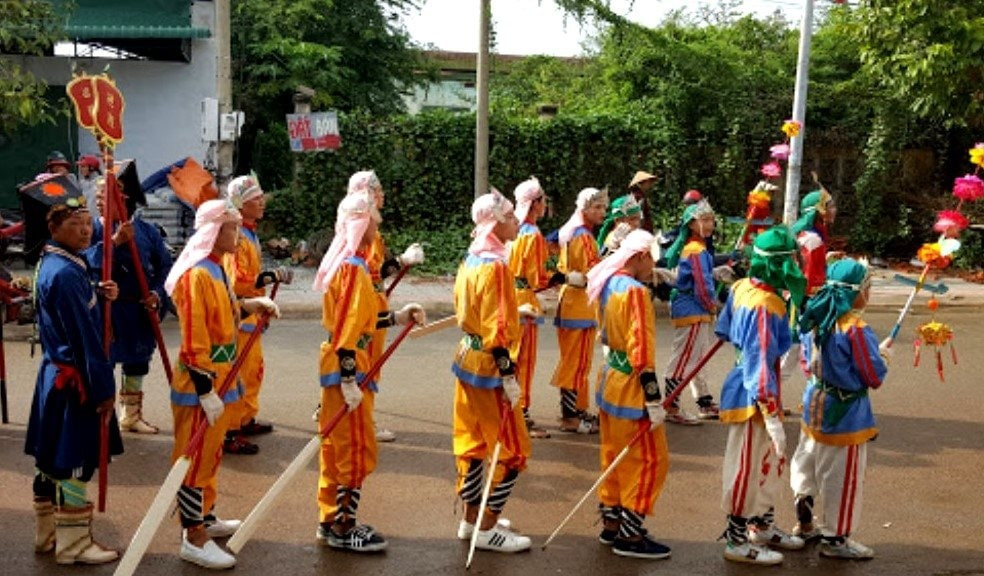
However, limited financial resources—dependent almost entirely on community contributions—have constrained restoration efforts. Only essential repairs and small-scale festivals could be maintained. Even the annual Whale Worship Festival has gradually been reduced to a single ceremony or a symbolic boat procession carrying five-colored flags around the small Thien Y islet on the Whale Goddess’ anniversary (20th day of the third lunar month).
Nevertheless, these events still draw crowds and sustain vibrant coastal spirit. Nearby fishing temples along the 20-kilometer shoreline, from Ho Tom (Phuoc Loc) to Tan Long, Tam Tan, Ba Dang and Ke Ga, often join the festivities.
Yet with rapid urbanization, declining marine resources and the need for larger-capacity fishing vessels, traditional livelihoods have changed. Iconic fish varieties once abundant such as mackerel, scad, tuna, and others have dwindled. As a result, economic constraints have reduced the community’s ability to contribute to rituals, festivals and cultural preservation.
Even so, in local belief, the communal house and whale temple remain a sacred spiritual home.
Challenges in Preservation and the Need for Revitalization
Since its national recognition in 2012, efforts to safeguard and promote the site’s heritage have progressed slowly, largely due to limited capacity within the community-appointed management board. As a cultural landmark with deep historical roots, Phuoc Loc Communal House - Whale Temple requires a comprehensive, scientific restoration plan to protect its architectural and spiritual character while enhancing its potential as a cultural tourism destination.
The Binh Thuan Museum once proposed restoring the whale skeleton and reorganizing the treasured whale bone relics. Yet for nearly 15 years, the sacred halls honoring the Whale God, the Guardian Deity, and ancestral founders have remained mostly closed, and the spacious grounds, surrounded by bustling neighborhoods, ports and schools, continue to appear neglected.
These relics are not only linked to legend but also reflect the region’s marine ecosystem and the cultural identity of generations of fishing communities, forming a sacred heritage space grounded in Vietnamese spiritual tradition.
Despite its national status, the site still lacks effective heritage promotion, community engagement and cultural programming. With limited financial resources and reliance on voluntary contributions from fishermen, full preservation and revitalization remain significant challenges.