

Clean Agriculture: Turning Agricultural Waste into Organic Fertilizer
A variety of agricultural by-products such as rice straw, corn stalks, sugarcane bagasse, and fruit peels can be repurposed into animal feed or organic fertilizer — helping farmers cut production costs and make better use of natural resources.
Harnessing Agricultural Strengths
With more than 1 million hectares of cultivated land in 2025, Lam Dong remains one of Vietnam’s leading agricultural provinces. Alongside this advantage, many local farmers have successfully implemented models that reuse agricultural by-products.
Beyond traditional composting methods, many forms of agricultural waste are now being creatively repurposed. For example, pineapple fiber is turned into eco-friendly textile material; rice straw is used to grow mushrooms, feed livestock, and produce fertilizer; and livestock waste is converted into biogas. Similarly, seafood processing residues are transformed into animal feed and fertilizer.
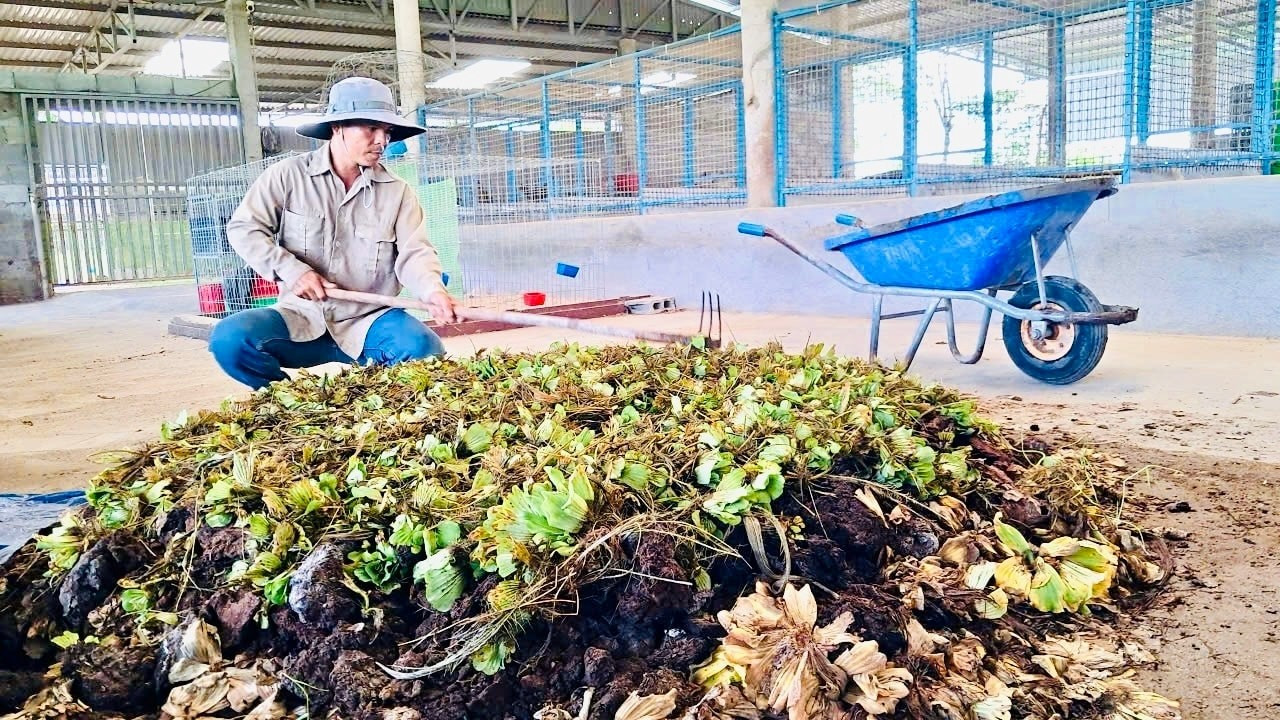
In Ham Liem commune, farmer Phan Viet Hung manages a 1.5-hectare apricot garden. Starting with cattle and goat farming, he began using animal manure combined with probiotics to make organic fertilizer for his apricot trees. Later, when he stopped raising livestock, he continued using microorganisms to process aquatic weeds and marine fish waste into organic compost. “This method keeps the soil loose, helps the trees grow strong, and cuts fertilizer costs by two-thirds compared to buying commercial products,” Hung shared. His trees now grow more sustainably thanks to organic fertilizer — improving productivity while protecting the environment.
Science and Technology Transfer
Mr. Hung is among many Lam Dong farmers applying microbial technology to convert agricultural waste into organic fertilizer with notable success. However, a large volume of by-products still goes unused or is discarded — often through open burning of straw or improper waste disposal — causing pollution and waste.
Recently, the National Agricultural Extension Center and the Lam Dong Agricultural Extension Center held a training course on “Microbial Technology for Processing Agricultural Waste into Organic Fertilizer.” The program attracted farmers, cooperative members, and farm owners from across the province. Participants learned about using microbial organic fertilizer in farming and building on-farm composting models.
According to the provincial Agricultural Extension Center, recycling agricultural by-products into organic fertilizer is a sustainable approach that enhances soil fertility, reduces dependence on chemical fertilizers, and supports circular agriculture. Techniques such as composting, vermiculture (earthworm composting), and biological inoculants can all be applied effectively.
Master Le Van Dac, Head of the Livestock–Aquaculture Division at the Lam Dong Agricultural Extension Center, emphasized that the province’s strong agricultural base gives it a clear advantage in developing circular and organic farming. “By applying microbial treatment to agricultural residues, farmers can create organic fertilizers that improve productivity, reduce chemical use, and promote sustainable agriculture,” he noted.
The Center is currently implementing several pilot projects promoting clean agriculture through waste-to-fertilizer conversion. Alongside these efforts, Lam Dong continues to expand training and technology transfer programs to help farmers adopt eco-friendly and efficient farming practices.