

Ritual Prayers of the M’nong People
For generations, the M’nong people of western Lam Dong province have preserved a rich cultural heritage, in which ritual prayers hold a central role. These prayers are deeply tied to the community’s beliefs and spiritual life. Every ceremony, whether large or small, is accompanied by a unique prayer, reflecting the M’nong worldview and philosophy of life, as well as aspirations for bountiful harvests and prosperous villages.
Sacred words, sacred meanings
Prayers, delivered in rhythmic verse, express human wishes and petitions to the deities—asking for favorable weather, fertile crops, and abundance.
Rooted in the belief of animism, the M’nong hold that every event in life is influenced by spiritual forces. Thus, no important activity can proceed without an offering and a prayer.
In addition to communal rituals—such as festivals marking harvests or ceremonies to strengthen ties among villages—the M’nong also maintain prayers linked to the human life cycle and agricultural production, carried out throughout the farming season.
At every ceremony, offerings of rice wine, food trays, and sacrificial animals such as buffaloes, chickens, or pigs are presented. Alongside these, the prayer is indispensable, voicing the community’s hopes for peace, prosperity, and unity.
Rituals that bind the community
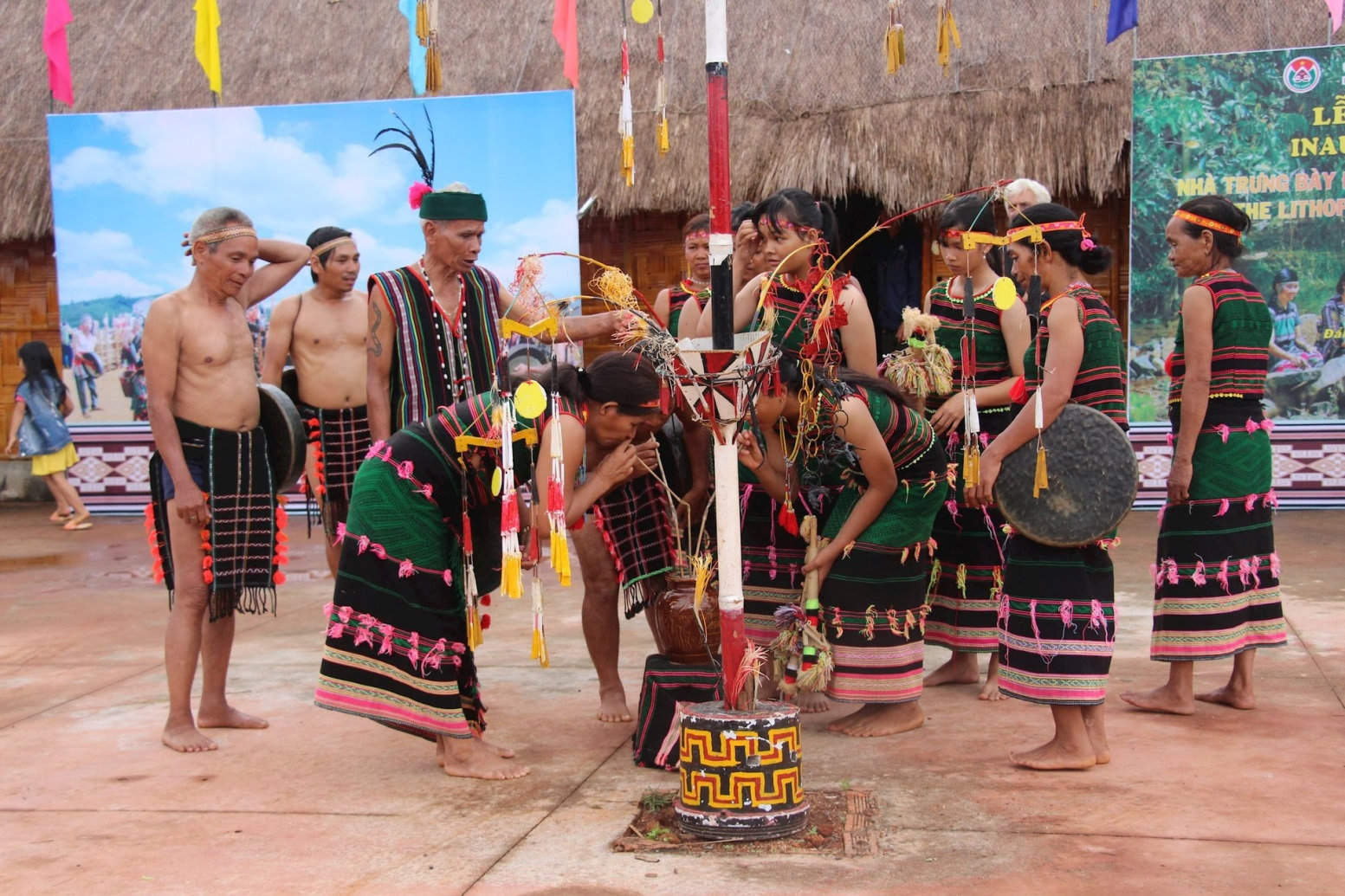
One notable example is the community gathering ceremony held after the harvest. The offerings typically include a chicken, a jar of rice wine, and a plate of sticky rice, all placed on a bamboo tray beneath a ceremonial pole (cây nêu). The event begins with resonant gong ensembles welcoming guests. Young men and women join hands, dancing in widening circles around the pole.
When the music ceases and guests have assembled, the village elder begins the prayer, calling for peace, prosperity, and solidarity among villagers.
Another significant rite is the coming-of-age ceremony, organized by parents for children aged 16–20 to mark their recognition as full members of the community. Because of its importance, the offerings are more elaborate: a pig and jars of rice wine. Both the elder and the initiate wear traditional M’nong attire while carrying out the ritual.
A typical prayer might begin:
“Oh spirits! This person’s parents have offered seven jars of rice wine and a pig to honor you. The meat will be shared with everyone. Whether the wine is strong or weak, drink with us; whether the meat is tasty or not, eat with us. Please bless this person with good fortune in all things…”
Living heritage
According to artisan Đieu Noi from Jieng Ngaih village in Tuy Duc commune, ritual prayers cannot be improvised or mixed up:
“Each ceremony has its own deity, meaning, and prayer. The officiant must know the texts by heart and understand their significance to deliver the right message to the gods and ancestors. Every line carries wishes and teachings for descendants to respect nature and uphold tradition. Preserving these prayers means preserving the cultural identity and pride of the M’nong in today’s changing world.”
The system of ritual prayers among the M’nong is not only a sacred part of ceremonies but also a living treasure of knowledge, history, and collective memory.
Each prayer has its own content, embodying the ultimate purpose of the ritual it accompanies. Through collection and translation efforts, Lam Dong’s cultural authorities have gathered more than 50 representative ritual prayers of the M’nong people to date.