

Ethnic Minority Communities in Ka Do Develop the Dairy Cattle Farming
Many ethnic minority households in Ka Do Commune, Lam Dong Province, have embraced dairy cattle farming, investing confidently in the sector and improving their livelihoods.
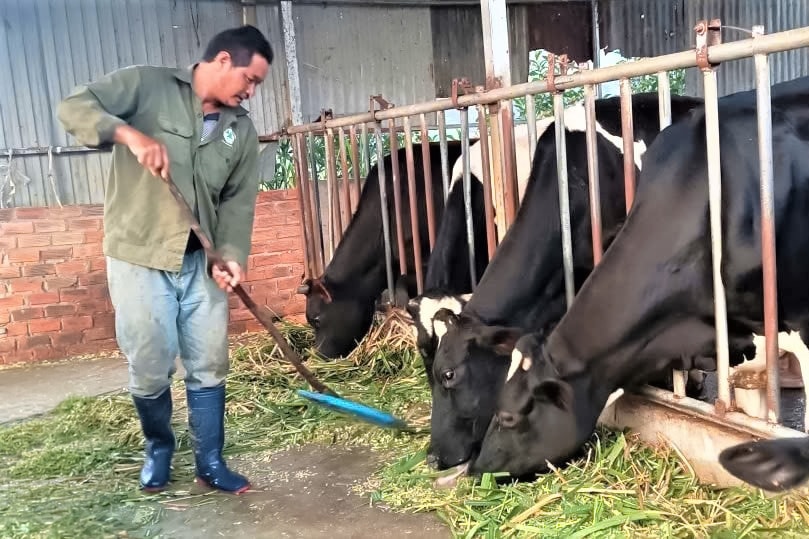
Pioneers in Dairy Farming
In M’rang Village, Ka Do Commune, K’Ngoan, a 42-year-old K’ho resident, was the first in his village to venture into dairy farming. When we visited, he was busy feeding his cows in a barn next to his house.
M’rang is one of the six villages in Ka Do Commune that hosts ethnic minority communities, out of a total of 19 villages in the area. Similar to many other K’ho families in M’rang, K’Ngoan’s family previously depended solely on cultivating rice and vegetables.
But with limited farmland and unstable vegetable prices, income remained uncertain. After seeing Kinh families in nearby communes earn steadier incomes from dairy farming, he discussed the idea with his wife and took out a state-backed loan in 2023 to buy cows and gradually build up his herd.
At present, his family has a total of 10 dairy cows, including 4 that are currently producing milk. From these 4 cows, they generate approximately 50–60 liters of milk daily. The fresh milk is sold to a collection center for around VND 15,000 per liter, creating a reliable source of income.
Another ethnic minority household leading in dairy farming is that of Dinh Van Leo, a 56-year-old man from the Ho Re ethnic group, residing in Ta Luy 1 Village. He initially took out a loan from the bank to invest in dairy cows. Currently, his family owns 6 dairy cows, with 4 of them producing milk. On average, he collects between 60 and 70 liters of milk each day. After deducting expenses, his family earns over VND 20 million per month.
Eager to Learn
To achieve their current success, both K’Ngoan and Leo said they had faced many challenges in dairy farming.
For K’Ngoan, the first year was especially difficult, as his family lost four cows in an outbreak due to limited experience in disease prevention. But rather than discouraging him, the setback only strengthened his determination. “If others can succeed, I can too,” he said. He improved the cowshed to make it cleaner and better ventilated, invested in equipment, and paid greater attention to nutritious feed to improve milk quality.
Regarding Leo, his extensive experience and successful disease prevention strategies have helped his family navigate outbreaks. However, he says that cow farming is akin to tending to young children, as it demands constant supervision. “There are times when I wish to travel further, but I can't,” he remarked.
He also emphasized that managing a dairy farm requires hard work, routine barn cleaning, and washing the cows before milking. Having access to clean drinking water is crucial, and his family cultivates grass while also purchasing additional feed from larger suppliers. As for cow manure, he occasionally sells it to local vegetable-farming households, earning approximately VND 2 million per truckload.
Ka Do Commune is home to nearly 28,000 people, including more than 5,300 ethnic minority residents from over 1,200 households, who make up 22% of the population.
The majority of ethnic minority residents engage in agricultural work, primarily cultivating vegetables, while numerous families also raise beef cattle. Recently, several ethnic minority households have taken the initiative to invest in dairy farming.
Vice Chairman of the People’s Committee of Ka Do Commune Nguyen Van Hop said the commune has long prioritized high-tech agriculture in vegetables and flowers. At the same time, local authorities continue to encourage livestock farming, especially dairy cattle, as a stable livelihood option for residents, particularly ethnic minority households with the means to invest.