

Digital Transformation Drives a Breakthrough in Agriculture
From building digital infrastructure and applying advanced technologies to training digital farmers, Lam Dong is transforming production, strengthening management, increasing agricultural value, and moving toward a modern, green and sustainable agricultural sector.
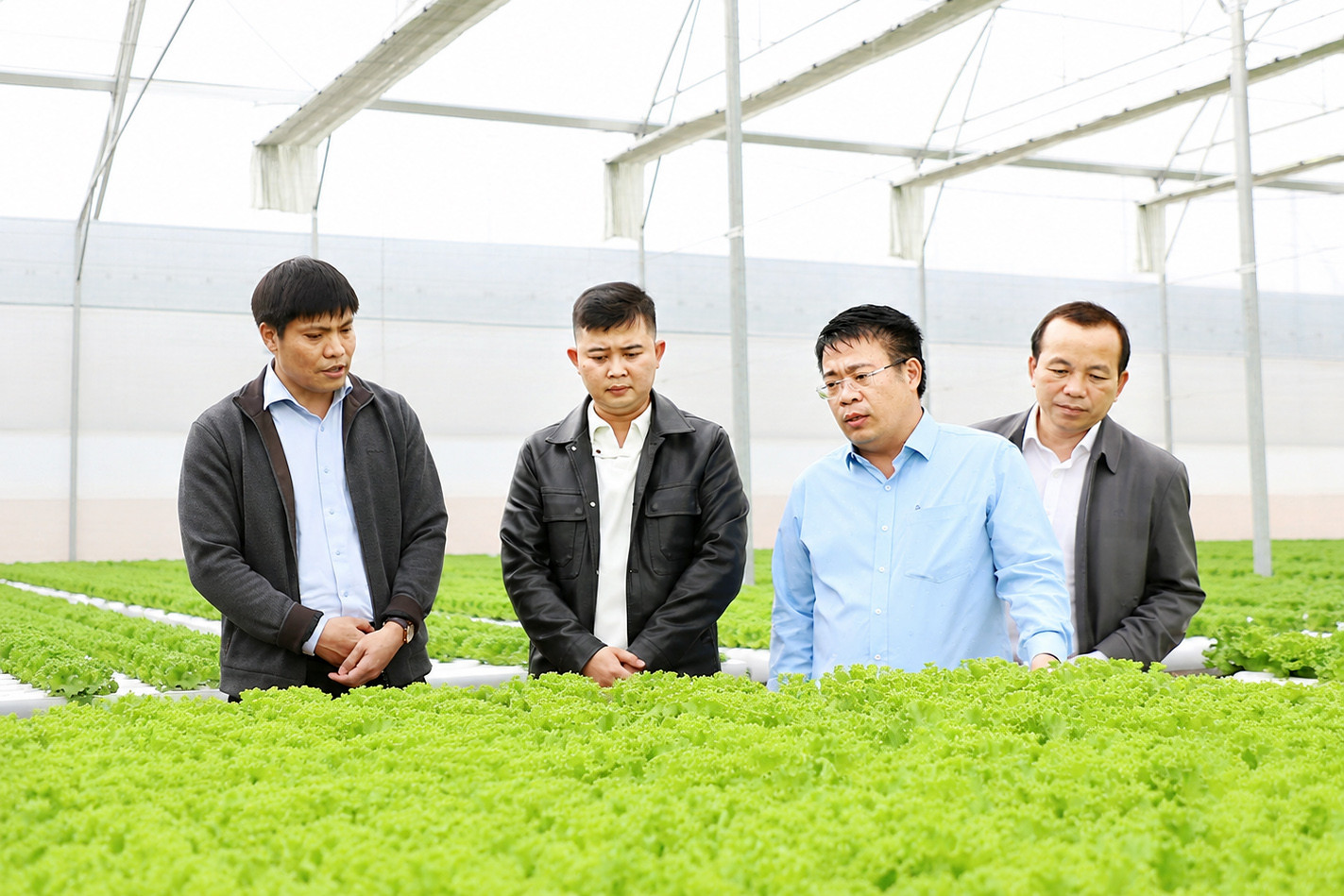
Digital Transformation: Modernizing Agricultural Infrastructure
Following the orientations set by the central government and the province, Lam Dong’s agricultural sector has gradually shifted from traditional production toward management and production systems based on science, technology and data.
The implementation of Resolution No. 57-NQ/TW is creating a foundation for the province’s agriculture to develop in a modern, green and circular direction while increasing added value.
According to the Lam Dong Sub-Department of Crop Production and Plant Protection, by the end of the second quarter of 2026, the province had recorded 109,500 hectares of high-tech crop production. Of this, about 1,400 hectares used smart technologies, including sensors, Internet of Things (IoT) connectivity, and automated systems for irrigation, nutrient management and monitoring of cultivation conditions.
Speaking about the implementation of Resolution No. 57 in agricultural production, Tran Quang Duy, Deputy Head of the Sub-Department of Crop Production and Plant Protection, said the effort focuses on three core pillars.
The first is modernizing production infrastructure by connecting greenhouses, net houses and irrigation systems with sensors, weather and soil data, and automated control devices.
The second is developing digital data on production areas, cultivation-zone boundaries, pests, agricultural inputs, farming logs and batch-based traceability.
The third is standardizing technical processes, implementing integrated crop health management, ensuring the safe use of plant protection products and organizing value-chain linkages.
Alongside modernization, green, circular and low-emission agricultural models are also expanding. Data released in June 2026 showed that nearly 154,000 hectares of crops had been certified or produced under safe and sustainable standards, including nearly 126,300 hectares under UTZ, 4C and Rainforest Alliance standards; 23,600 hectares under GAP and equivalent standards; and 4,050 hectares of organic production.
Meanwhile, the issuance and management of cultivation-area codes have been systematically implemented. A total of 1,467 cultivation-area codes covering nearly 51,158 hectares and 540 packing-facility codes have been completed, providing a solid “passport” for Lam Dong’s agricultural products to reach international markets.
Lam Dong aims to raise the average product value to VND250 million per hectare of cultivated land by 2030. The target is based not only on higher productivity but also on crop restructuring, technology adoption, improved quality standards, processing development and stronger market linkages.
.jpg)
Mastering Technology and Expanding Smart Farming Models
If technology infrastructure and digital data provide the foundation for transformation, farmers are the key actors determining its effectiveness.
From farms and cooperatives to individual producers, proactive access to and mastery of technology are creating new production models in which technology is directly used to reduce costs, save labor and improve management efficiency.
One example is the production model operated by Pham Van Hieu, owner of VH Farm in Hiep Thanh Commune.
Starting with a combination of dairy farming and crop production, Hieu has introduced comprehensive mechanization and automation throughout the production process. For his herd of 30 cows, feeding and barn cleaning have been mechanized.
Since 2022, he has also attached tracking chips to individual cows to monitor their health and manage the herd remotely via mobile devices. Cow manure is treated with microorganisms to produce fertilizer for crops, while treated wastewater is used to irrigate four sao of grass grown to feed the herd.
On two thousand square meters of greenhouse where tomatoes are grown on substrates, Hieu has invested in an IoT sensor system that automatically regulates fertilizer and irrigation while monitoring the entire growth cycle with just a few taps on a smartphone.
“With the support of modern machinery, farming today is much easier. It saves time and effort, and I can handle many tasks on my own, from livestock farming to crop production. This gives me more time to participate in social activities in the locality,” Hieu said.
Closed-loop circular agriculture combined with technological mastery, as demonstrated by Hieu’s model, is becoming increasingly widespread.
To help farmers and cooperatives strengthen their management capacity, local authorities and community agricultural extension groups have organized modular training, provided direct guidance in fields and developed shared services.
According to the Sub-Department of Crop Production and Plant Protection, by the end of June 2026, the province had established 59 community agricultural extension groups across 59 of its 124 communes, wards and special administrative zones.
Together with 428 value-chain linkages involving 47,590 households, the community agricultural extension network serves as a direct channel for technology transfer, shared-service organization, standardized production logs and market connections.
Training effectiveness is assessed through the ability to operate technology, reductions in input costs, compliance with production processes, traceability quality and the stability of market outlets, rather than by the number of devices individually invested in by each household.
According to Tran Quang Duy, to develop human resources capable of meeting the requirements of the new transformation process, the provincial People's Committee issued Plan No. 11256 on July 14, 2026, on improving the quality of the agricultural workforce and developing a new generation of digital farmers, professional farmers and modern cooperative management teams for 2026-2030.
From infrastructure investment and digital data development to the spread of technology across individual production models and workforce training, the implementation of Resolution No. 57 is creating increasingly visible changes in Lam Dong’s agriculture.
Science, technology and digital transformation are gradually becoming practical tools for producers to strengthen management capacity, reduce costs and increase value.
The achievements recorded over the past period, particularly after one year of implementing Resolution No. 57, have affirmed the province’s strategic direction of making science and technology a key driving force.
The consensus among management agencies, businesses and farmers is not only helping address production challenges but also fostering a new generation of professional “digital farmers,” laying the groundwork for Lam Dong’s high-tech agriculture to develop sustainably and modernly in the new period.
Under Plan No. 11256 dated July 14, 2026, the province will provide training and capacity-building programs for 117,250 participants, including digital skills training for 46,000 farmers.
Training will focus on operating digital equipment, IoT systems and unmanned aerial vehicles; QR-based traceability; cost accounting; value-chain linkages; e-commerce; organic production; green and circular agriculture; and carbon credits.