


Reviving the traditional ethnic basket-weaving craft at the foot of Ta Ngao Mountain
At the foot of Ta Ngao Mountain lies a small K’ho village where a number of men still preserve the traditional craft of weaving everyday utensils. They are now striving to pass this ancestral skill on to younger generations, hoping that the dexterous craftsmanship of their forebears will continue to live on.
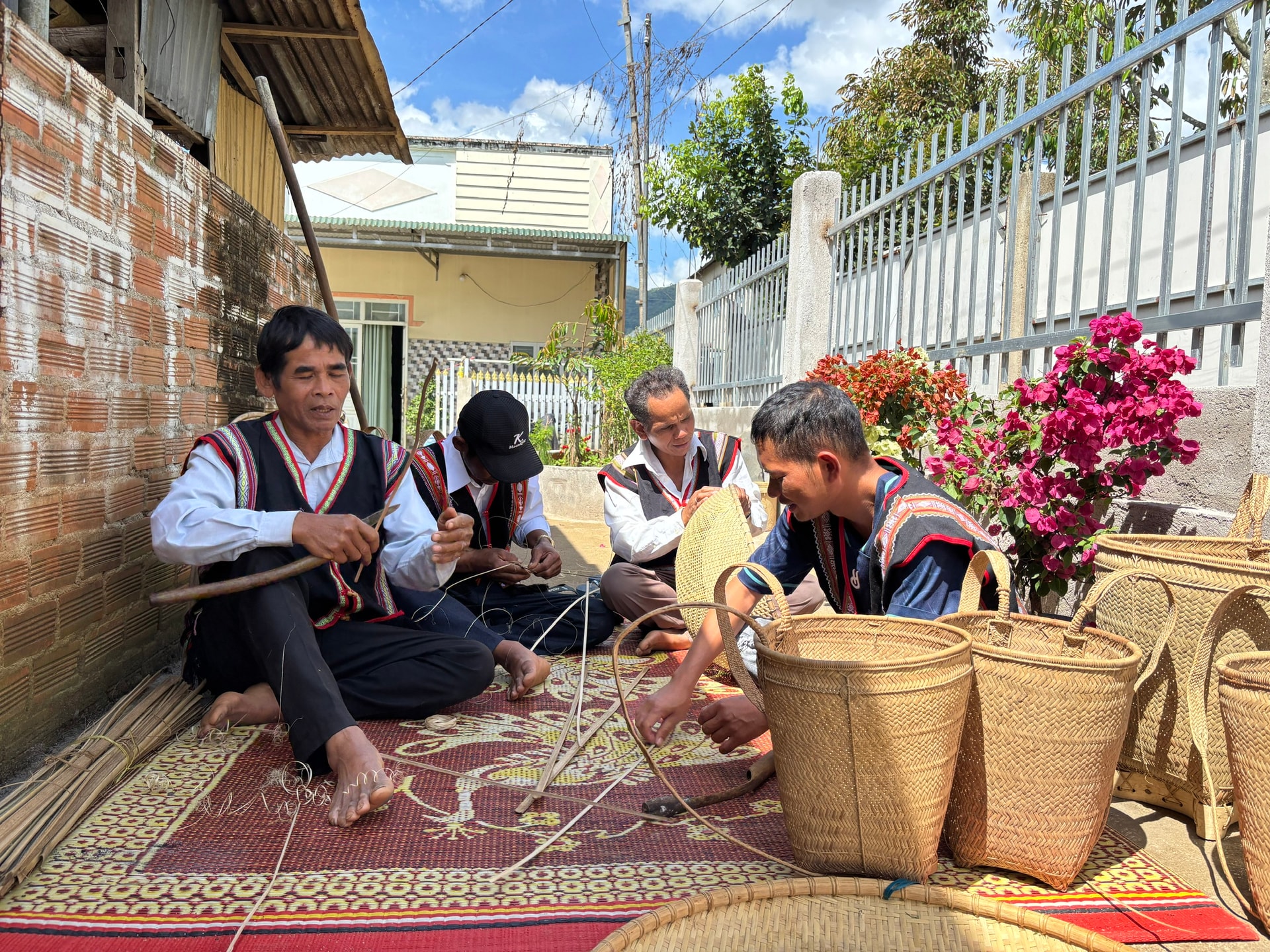
The traditional ethnic basket in K’ho daily life
“In the past, during our grandparents’ time, weaving baskets, trays and bamboo containers was very common. Almost every man in the village knew how to do it. Today, however, the widespread use of plastic and metal items has caused the weaving craft in the village to gradually fade,” said K’Van Deo, a master craftsman known for his skilled hands and one of the most experienced basket weavers in Hamlet 15 of Bao Lam 3 Commune.
K’Van Deo recalled that K’ho men in Da T’rang village (the former name of Hamlet 15) each owned a specialized knife used for weaving. The knife has a distinctive shape and is designed for splitting bamboo strips, cutting rattan and preparing “lo o” bamboo. According to him, the knives were forged locally by villagers themselves using steel over open fires.
In the old days, men in the village often went into the forest to cut bamboo and “lo o”, then carefully split and shave them into thin strips. The strips were dried and later hung above the kitchen fire to be smoked. Baskets made from these smoked bamboo strips were flexible, beautiful and very durable – people could carry them to the fields for decades without damage
K’Van Deo - Hamlet 15, Bao Lam 3 Commune.
During the long rainy season in the Central Highlands, villagers could not work in their fields. On those days, the men of Da T’rang stayed home weaving baskets, trays, containers and fish traps—making nearly all of the household tools used in daily life. For generations, items made from bamboo, rattan and “lo o” have remained closely tied to the lives of the K’ho people.
However, K’Van Deo acknowledged that over time, metal and plastic utensils gradually replaced many traditional items in the homes of residents in Hamlet 15. As a result, the weaving craft declined. “The “pét s’chút” knife now lies quietly above the kitchen hearth, with no bamboo left to split,” he said, recalling how the once-busy tool has fallen silent.
Reviving an ancestral craft
“Now I’m learning to weave traditional baskets from the older men in the village. My father used to weave at home, so I already know some simple techniques, but weaving a proper carrying basket requires long and careful training,” said K’Bun, a young K’ho resident.
He noted that demand for bamboo and rattan tools has recently begun to recover. Villagers themselves prefer to use traditional woven items again, while visitors are also interested in K’ho traditional baskets and trays as cultural products.
K’Van Deo said he often spends long rainy days making baskets. Although the process is labor-intensive, the selling price is relatively good. Large, well-crafted baskets can fetch around one million dong each. With tourism developing around Bao Lam area, woven bamboo and rattan products have found a growing market, and craftsmen can sell as many items as they produce.
K’Nhuy, a young K’ho woman in Hamlet 15 who collects woven baskets and rattan containers from villagers for resale, said that as living standards improve, many people are returning to products made from natural materials.
“Even within the village, people have begun using woven baskets again when going to the fields or gathering vegetables. I also buy these products and sell them to tourists or online, and they sell very well,” she said. The renewed demand is helping revive a traditional craft of the local community.
Nguyen Van Trang, head of Hamlet 15, said that after a long period of decline, the village’s weaving craft has recently shown signs of recovery. Many households are once again producing baskets for the market and teaching the skills to younger generations.
He emphasized that the traditional weaving craft of the K’ho community is gradually being revived, with elders willing to pass on their knowledge to the youth. The products are selling well, providing additional income while preserving an age-old craft practiced for generations by residents living at the foot of Ta Ngao Mountain.