


Silky Threads from Wild Pineapples in Phu Quy
Over the years, the lush green hills of wild pineapple on Phu Quy Island have remained an invaluable resource for residents. Traditionally, the roots of mature plants are used to weave hammocks, while the ripe golden fruits are soaked to make fragrant pineapple wine. Today, from those humble hammocks, this native plant is creating new opportunities for local women, who may soon produce contemporary woven fabrics from pineapple fibers—turning them into soft, silky textiles that reflect the island’s unique identity.
Unlocking the Potential of a Native Plant
Every April, when the weather turns dry and calm, wild pineapple forests—also known as screw pine—bear clusters of ripe golden fruit hanging beautifully from their branches. During this season, many island women head out with baskets to harvest the fruit, which is then died and sold to local diners and restaurants for producing pineapple wine, providing an extra source of income.
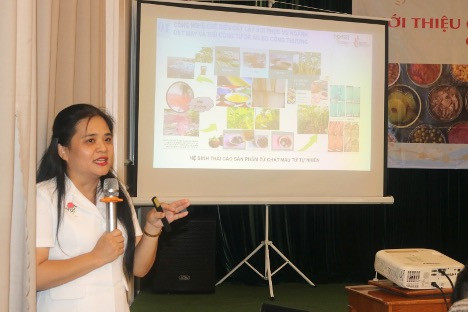
On a trip to Phu Quy in April this year, Dr. Pham Thi Hong Phuong (Senior Advisor at the Center for Innovation, Startups & Technology Transfer – Ho Chi Minh City University of Industry) was deeply captivated by the stretches of vibrant green pineapple hills and their ripe fruit. The trip also added vivid real-life context to her presentation to local women’s associations about a model that transforms this native plant into fabric fiber derived from its stems, branches, and roots.
The training session—organized by the Binh Thuan Union of Science and Technology Associations and the Phu Quy District People’s Committee—offered women’s groups fresh opportunities to explore a new profession rooted in the island’s indigenous plant resources.
Dr. Hong Phuong shared: “Wild pineapple forests stretching endlessly across the island are a rare and distinctive native resource, ideal for producing soft silk-like fabric. In the northern part of the island, women have long harvested the dried roots of mature plants to hand-weave traditional hammocks—a craft still preserved by a few households today. Many women now collect ripe fruit to supply local culinary businesses serving an increasing number of tourists. If local women’s organizations can cooperate and process this plant properly, it will create jobs and generate much higher economic value.”
Diversifying Tourism Products
Previously, under a program commissioned by the Department of Industry under the Ministry of Industry and Trade, Dr. Pham Thi Hong Phuong—herself a native of Ham Kiem—successfully developed machinery capable of extracting fiber from pineapple stems, branches, and roots. This breakthrough enables the production of long, fine fibers that were once nearly impossible to obtain manually.
These fibers are then put through a closed-loop treatment system that adjusts their structural composition, increasing cellulose content to a level suitable for spinning into thread. The resulting fabric maintains the natural uniqueness of pineapple fiber while achieving a soft, smooth, silk-like texture. Pineapple fiber fabric has already been displayed and sold in parts of Vietnam and abroad.
“Now that we have the machines to extract fiber and spin it for weaving, we hope to transfer this technology to organizations and individuals wishing to produce commercially, making use of the abundant local supply of pineapple stems, branches, and roots across the Phu Quy special zone,” Dr. Phuong explained.
“In the future, pineapple fabric products can be showcased in hotels, restaurants on the island, and even in coastal resorts of Southeast Lam Dong, allowing Vietnamese and international tourists to experience and purchase them. This not only helps preserve local culture but also enriches marine tourism products.”
She added: “Organizations and individuals—especially those in Phu Quy—interested in startup models using this native resource can contact the Department of Science and Technology for technology transfer collaboration. We also plan to partner with businesses to help bring Phu Quy silk products to the market.