


Strong on the Sea, Prosperous from the Sea
The Resolution of the 3rd Plenum of the 14th Party Central Committee on renewing Vietnam's development model sets out five guiding viewpoints and seven key strategic tasks and solutions with a long-term, comprehensive vision. The resolution aims to realize the nation's aspirations and turn Vietnam into a developed, high-income country by 2045.
In economic terms, the resolution establishes a new growth model driven by productivity, science and technology, innovation, digital transformation, green transition, and high-quality human resources. Among its key objectives is to build Vietnam into a strong maritime nation, prosperous from the sea, and a leading competitor in the region's marine industries.
The sea and ocean are to become a strategic development space and a long-term growth driver. Vietnam will formulate and implement a development strategy centered on maritime space, maritime-oriented economic corridors, and the ocean, with development extending toward the midlands, mountainous areas, and border regions. The country will also develop a modern, green, digital, self-reliant and dual-use maritime industry.
The importance of the sea and oceans in the 21st century is increasingly evident, with most coastal countries around the world placing a strong emphasis on developing their marine economies. Vietnam has a coastline of 3,260 kilometers, ranking 27th among 157 island nations, coastal countries, and territories worldwide.
The central government's identification of Vietnam as a strong maritime nation and a country that prospers from the sea represents a strategic vision at a time when countries around the world are increasingly looking seaward. As a locality with a coastline, Lam Dong will implement this strategic direction in the coming period, contributing to the realization of the Central Party Committee's resolution.
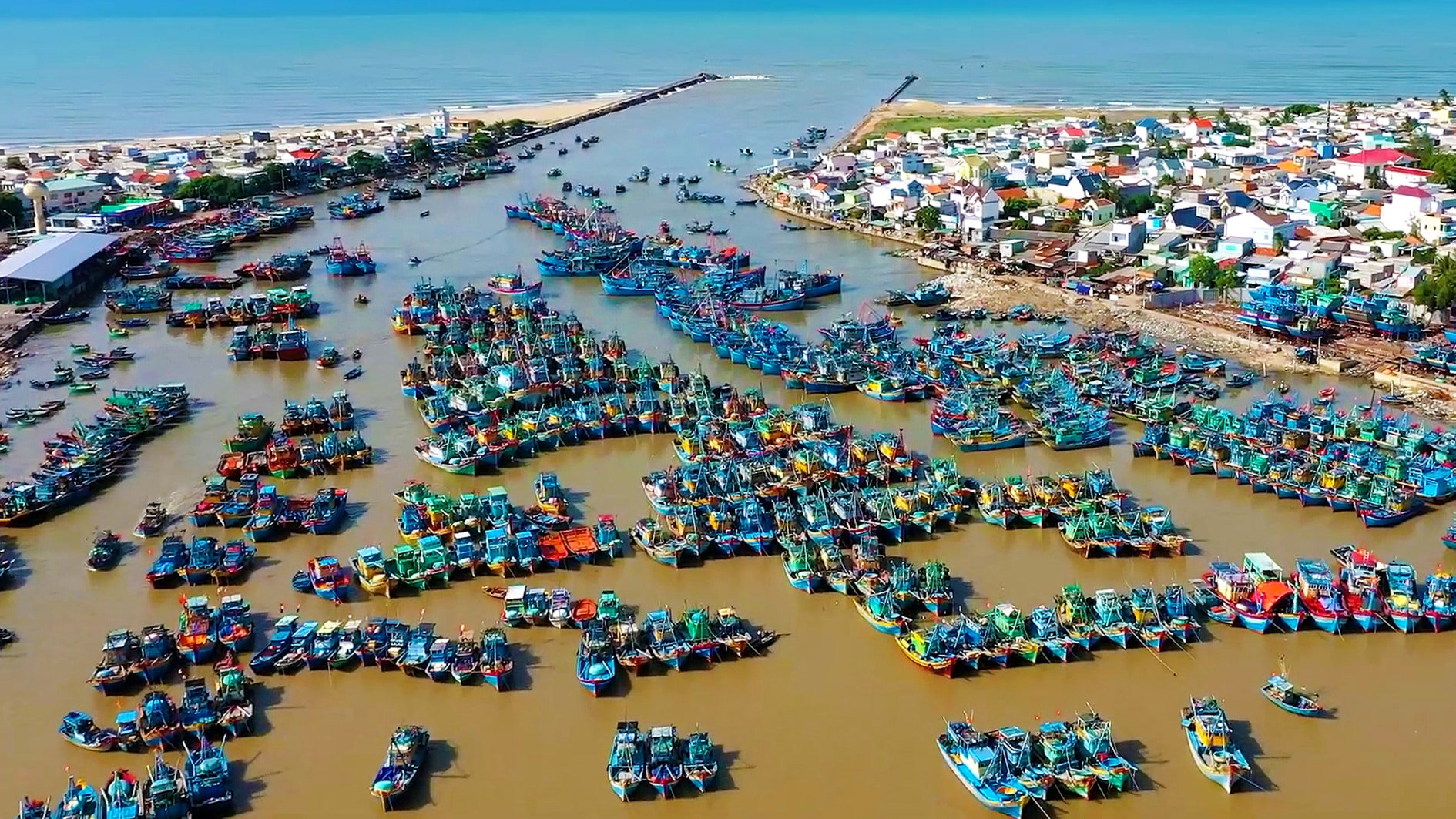
Lam Dong manages a fishing ground covering approximately 52,000 square kilometers, one of the three largest fishing grounds in the country. The area has a rich diversity of marine species, including many rare and high-value seafood resources. The province also has 192 kilometers of coastline, with numerous picturesque beaches, pristine landscapes, and a warm, fresh climate year-round.
In recent years, Lam Dong has invested in its maritime transport infrastructure and developed a number of seaports, including Phan Thiet Port and Phu Quy Port, particularly Vinh Tan Port. Its current infrastructure can accommodate vessels with capacities of 50,000–70,000 DWT. These advantages provide an important foundation for Lam Dong to implement the Strategy for Sustainable Development of the Marine Economy to 2030, with a Vision to 2045. Major export commodities associated with the province's coastal and island areas, including oil and gas, seafood, and ilmenite concentrate, make significant contributions to export turnover.
In addition, the energy industry in coastal areas and on Phu Quy Island is growing, with solar and wind power being effectively harnessed. Offshore fishing is also a key strength of the province and continues to be promoted in conjunction with efforts to safeguard national sovereignty over the sea and islands.
However, marine tourism development remains below the province's potential and advantages. Tourism infrastructure is still limited and, in many areas, lacks synchronization, making it less attractive to investors.
The management of marine resource exploitation and fishing also faces difficulties due to insufficient equipment and personnel, resulting in limited effectiveness. Meanwhile, fishery resources, particularly high-value species, are increasingly depleted due to the impacts of climate change and illegal or non-compliant fishing practices.
It must be acknowledged that the marine economy has significant growth potential, with greater emphasis being placed on planning and investment in coastal and island infrastructure. Lam Dong is gradually completing its coastal infrastructure, including seaports, transport routes, and maritime channels, to connect coastal development centers with the rest of the country.
Under the new development orientation, the marine economy's growth model will be restructured toward closer integration among sectors, linking the development of marine economic industries with marine economic centers, coastal tourism hubs, and coastal commercial centers. The province will continue accelerating investment in wind and solar power projects, prioritizing the combination of renewable energy development and tourism in the coastal areas of Tuy Phong, Mui Ne, Phu Quy, Ke Ga, Ham Tan, and La Gi.
Greater efforts to attract investment in the construction of La Gi and Son My ports, as well as the upgrading of Phan Thiet and Phu Quy transport ports, will contribute to the development and diversification of maritime services. This will facilitate pilotage, logistics, cargo handling, and other services, helping attract shipping lines and large-capacity vessels to call at local ports in the future.
The direction for developing the marine economy has been established. To realize the goal of becoming a strong maritime nation that prospers from the sea, concrete plans and actions must be put in place starting today.