


Ta Dung National Park’s Reishi Mushroom Moves Toward Commercial Production
After two years of implementation, the project titled “Research and development of commercial products from reishi mushrooms sourced from Ta Dung National Park” has been officially accepted by the Department of Science and Technology. The results mark a transition from wild harvesting to the commercial development of this valuable medicinal resource.
Clarifying scientific value and medicinal properties of reishi mushrooms
Reishi mushrooms have long been regarded as a valuable medicinal herb in traditional medicine in Vietnam and across Asia. Modern studies have shown that reishi contains key bioactive compounds such as polysaccharides and triterpenoids, which offer anti-inflammatory, antioxidant, immune-boosting effects and support the treatment of chronic diseases such as cancer, diabetes, and cardiovascular conditions.
Ta Dung National Park in Lam Dong is considered a region with significant potential for medicinal fungi, particularly species in the Ganodermataceae family. Research on reishi mushrooms in this area not only helps clarify their scientific value, biological and ecological characteristics, and potential applications in medicine, but also provides an important foundation for the conservation and sustainable development of forest-based fungal resources.
Over the two-year period, a team of 12 experts and scientists from Tay Nguyen University, led by Associate Professor Dr. Nguyen Phuong Dai Nguyen, focused on assessing the diversity of Ganodermataceae species in Ta Dung National Park; identifying scientific value and biological activity; and developing propagation and cultivation processes for selected reishi species (Ganoderma spp.). The project also explored the production of high-value commercial products derived from reishi mushrooms.
The study collected 86 samples of Ganodermataceae fungi, conducted biological and ecological characterization, identification, and classification, and compiled a list of 14 species across two genera, including six species of Ganoderma and eight species of Amauroderma. This dataset provides important scientific evidence, contributing to the understanding of medicinal fungal diversity in the Central Highlands’ forests.
The research team also screened biological activities of several species, recording effects such as cytotoxicity against cancer cells, inhibition of cancer cell proliferation, support for diabetes treatment, and immune enhancement. These findings highlight the strong potential of Ta Dung reishi mushrooms for medicinal product development.
Associate Professor Dr. Nguyen Phuong Dai Nguyen stated: “The project does not stop at identification and classification but also focuses on evaluating biological activity, thereby developing commercial products and practical applications.”
Process completion and product development
Building on these findings, the project has developed a comprehensive dataset and specimen collection of Ganodermataceae species in Ta Dung National Park, and finalized propagation and cultivation processes for reishi mushrooms as raw materials for production. Two cultivation models have been established—one at a production facility and another under the forest canopy—helping ensure quality control and a stable supply of raw materials.
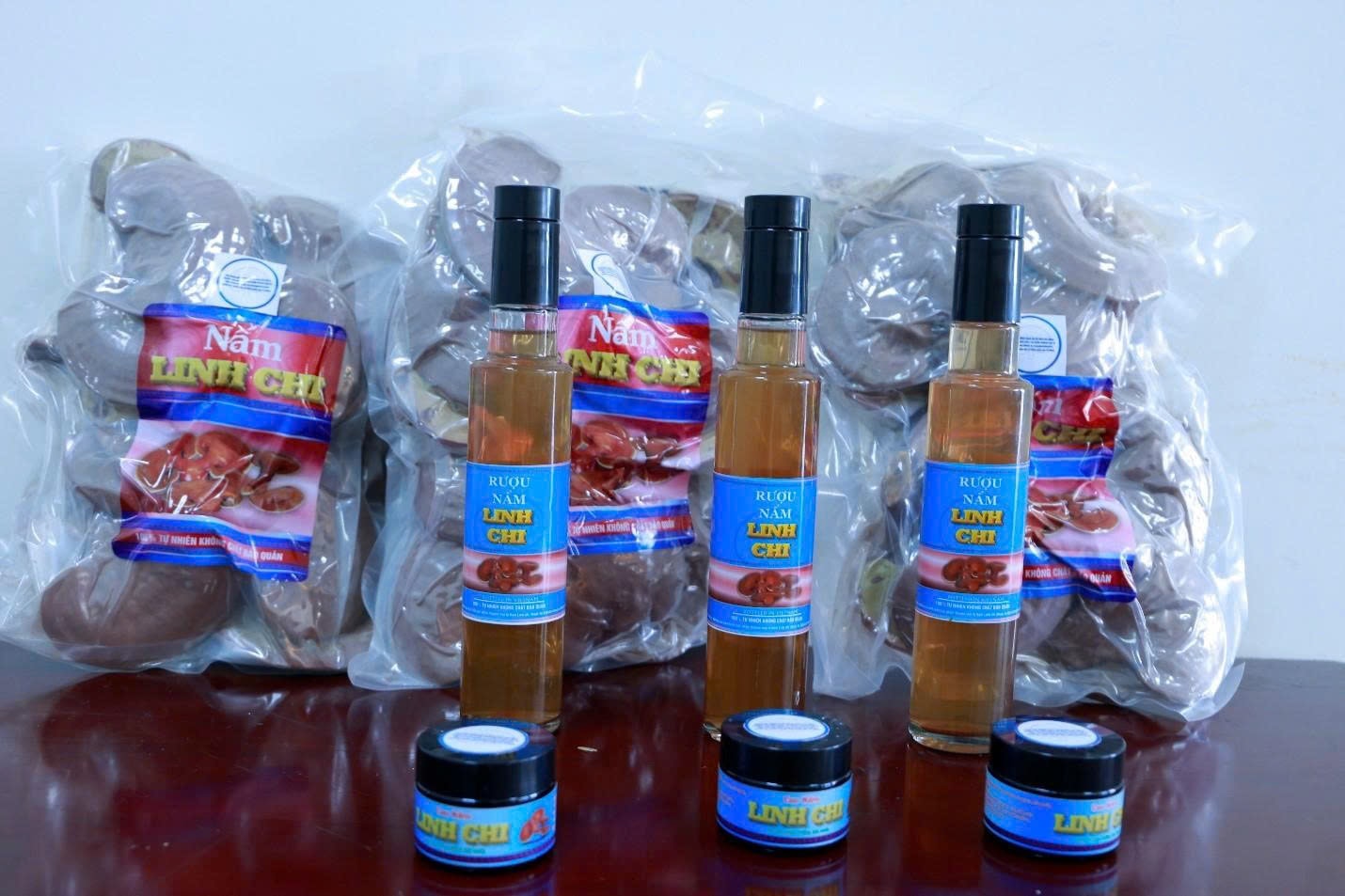
Based on this foundation, the research team has developed three commercial products: dried reishi mushrooms, reishi extract, and reishi wine. All products meet raw material standards, internal quality standards, and food safety requirements in accordance with regulations. The project has also established complete production processes for reishi extract and reishi wine, with clear and practical guidelines suitable for technology transfer.
In addition, trademarks for two products—reishi mushrooms and reishi extract from Ta Dung National Park—have been registered with the Intellectual Property Office. The project has also finalized processes for producing extracts with high bioactive content from reishi mushrooms, developed internal standards for each product line, and assessed the composition and levels of key bioactive compounds.
As wild reishi mushroom resources in biodiversity-rich areas such as Ta Dung National Park face depletion risks due to overexploitation, deforestation, and climate change, research into artificial propagation and cultivation is increasingly urgent. This approach not only helps conserve valuable genetic resources but also meets growing demand for medicinal materials in healthcare.
The project has been comprehensively implemented, from research, propagation, and cultivation to application and product development, with strong potential for transfer and replication, delivering practical effectiveness. It not only clarifies the scientific and medicinal value of Ta Dung reishi mushrooms, contributing to the conservation of valuable genetic resources, but also opens up pathways for sustainable medicinal development, creates livelihoods for local communities, and reduces pressure on forest resource exploitation.
Associate Professor Dr. Hoang Thi Kim Dung, Deputy Director of the Institute of Advanced Technology (Vietnam Academy of Science and Technology)