


The cultural beauty of the traditional weaving craft of the Cham People
Under the characteristic sunshine of the southeastern part of the province, the rhythmic sound of looms still echoes from several Cham households like a familiar melody. Although traditional brocade weaving is no longer widely practiced, it remains a vital cultural heritage, carrying stories of history, beliefs, and the daily life of an entire community — a legacy that Cham women continue to preserve.
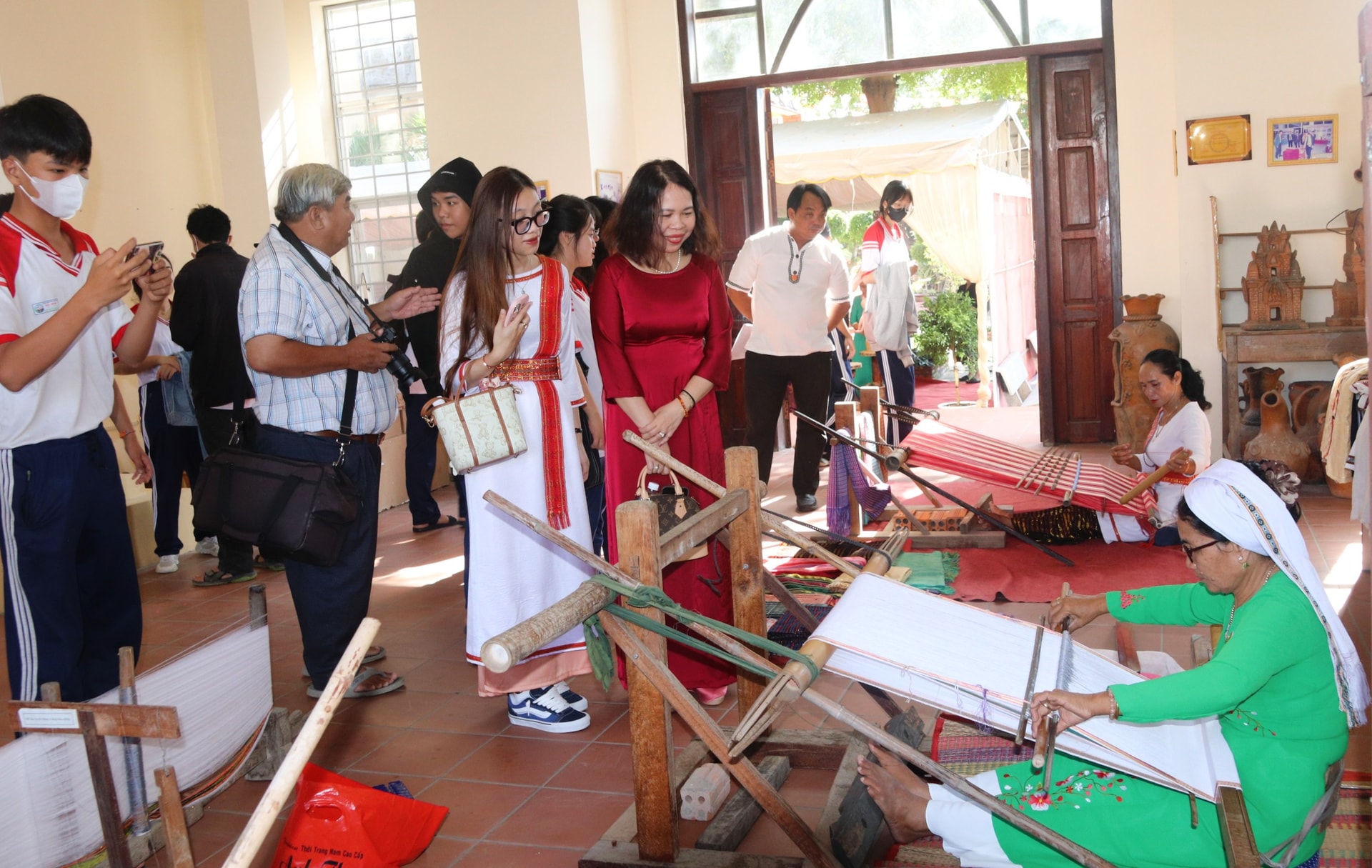
Each product is a unique work of art
According to documents preserved by the provincial museum, Cham weaving has a long history rooted in the Sa Huynh culture, considered a precursor to Champa civilization, and has continued to this day.
The art of Cham weaving is reflected in inscriptions, bas-reliefs, and ancient sculptures, and is most vividly represented in the Cham Royal Cultural Heritage Collection in Tinh My Hamlet, Hong Thai Commune. From an artistic perspective, each refined and visually striking brocade garment—whether worn by kings, officials, nobles, or ordinary people—is a unique work of art, clearly showcasing the craftsmanship and aesthetic sensibility of ancient artisans.
Artisan Dao Thi Dan, 71, from Binh Minh Hamlet in Bac Binh Commune, said weaving skills are traditionally passed down from mother to daughter or from grandmother to granddaughter. In the past, most Cham women knew how to weave, and the skill was regarded as a mark of proper conduct and an important criterion for evaluating women in Cham matriarchal society.
Producing a beautiful and delicate piece of brocade with diverse and intricate patterns requires artisans to go through multiple stages, demanding great effort and patience.
Beyond everyday use, carefully woven scarves, skirts, and shawls also serve as cultural and spiritual items of deep significance in traditional ceremonies such as weddings, festivals, and important religious rituals.
Promoting and preserving the traditional craft
Today, many traditional crafts face the risk of fading into oblivion, and Cham brocade weaving is no exception. In the province’s southeastern region, only a handful of elderly Cham Bani women in Bac Binh and Ham Thuan Bac communes remain steadfastly dedicated to preserving this craft.
Mrs. Ma Thi Thuan, a brocade weaving artisan from Lam Giang hamlet in Ham Thuan Bac commune, said that weaving requires patience, meticulousness, and many complex steps such as spinning thread, setting up the loom, and creating patterns. Each piece of fabric is woven entirely by hand and may take several days or even weeks to complete. Therefore, in the current context—when industrial fabrics are cheaper and more convenient—the traditional weaving craft faces many difficulties.
In response to this situation, the provincial museum and local authorities have stepped up efforts to introduce, promote and preserve the craft through cultural conservation programs. One goal is to foster a sense of ethnic pride among Cham women and encourage them to continue learning and practicing the craft.
In addition, during festivals and holidays, the Cham Cultural Exhibition Center and the Po Sah Inu Tower relic site invite artisans to give live weaving demonstrations. Through these real-life experiences, visitors can better understand the long-standing history and culture of the Cham people.
Each piece of brocade is not only a product of skillful craftsmanship but also a reflection of love for homeland and ethnic heritage passed down through generations. Despite many challenges, the sound of the loom still echoes daily in Cham villages. It is more than the sound of a traditional craft — it is the heartbeat of a cultural heritage being preserved, in the hope that Cham brocade will continue to be passed down to future generations.
The patterns on Cham woven products not only serve decorative purposes but also symbolize the cultural identity of the ethnic group. Artisans are like painters, creating distinctive designs that give brocade fabrics their beauty and visual appeal.