


The Symphony of the Great Forest Captivates Tourists
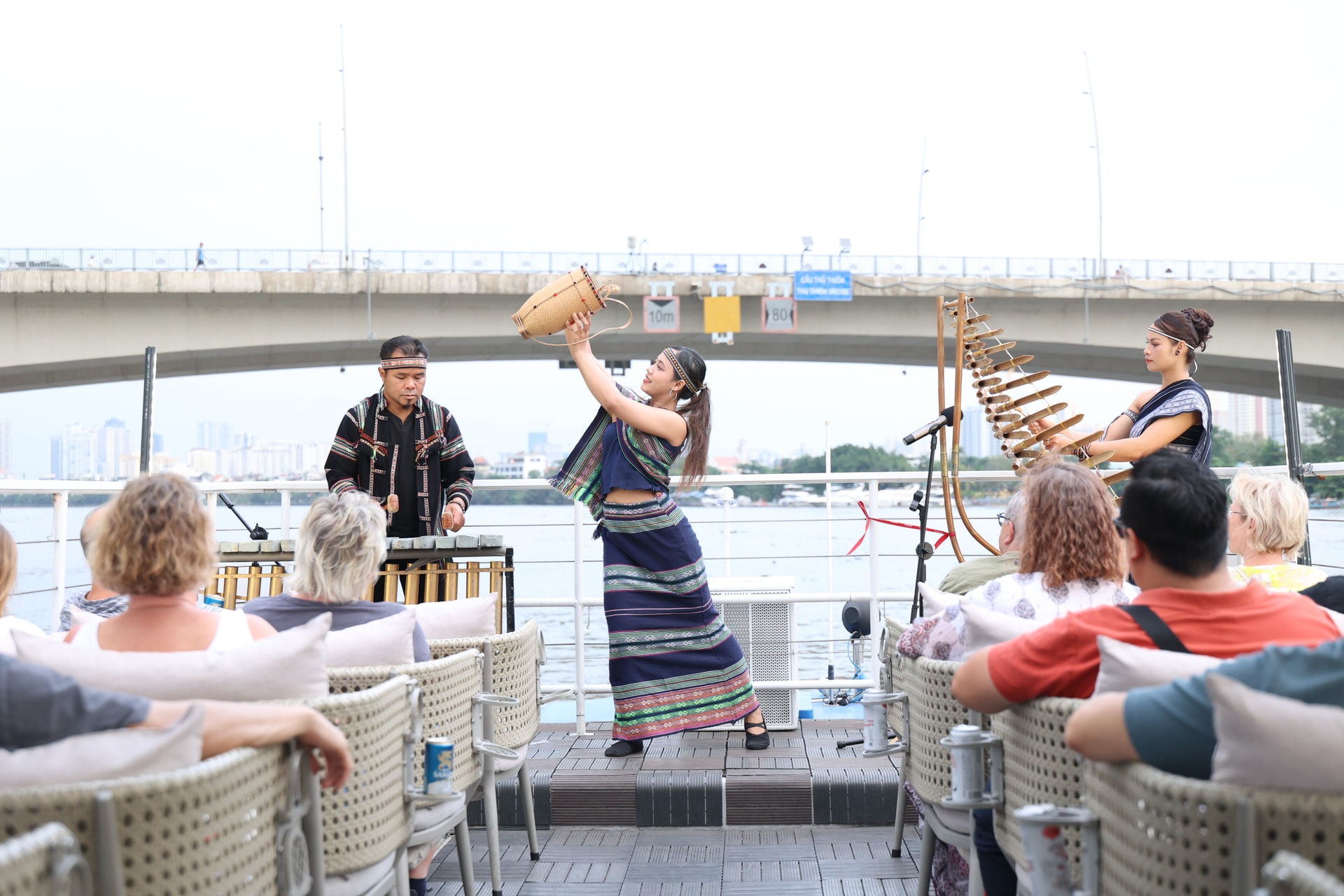
The image of young men and women dressed in traditional brocade attire amid the lively setting of a Saigon River cruise draws crowds of visitors, particularly international travelers. The xoang dance and the resounding gongs and drums—deeply rooted in the highlands—merge seamlessly with the city's pulse, forming a distinctive harmony that celebrates the rustic charm of Vietnam’s traditional culture.
A Unique Tourism Product
Since January 2026, under the expansive sky and glimmering city lights—where towering structures create reflections—rustic and familiar sounds from the mountains and forests have once again filled the air. The resonances of gongs, stone lithophones, t’rung bamboo xylophones, and klek klok instruments—unique to the Central Highlands villages—now echo in the center of the city. Once rich and profound, these sounds now carry a lighter, more crystalline quality, enchanting passengers on cruises along the Saigon River.
"I have been to Vietnam before, but this is the first time I've had the chance to truly experience your traditional arts. It's genuinely intriguing," remarked Andian, a traveler from India. Bathed in the golden light of the sunset, the sight of the young men and women from the Central Highlands becomes even more enchanting. Artist Krajan Dion, hailing from the Lang Biang Ward of Da Lat, performs with palpable passion, fully immersing himself in every beat of the gong and every movement of the dance. "We aim to showcase the most soul-stirring aspects of K’ho traditional culture, ensuring that each performance leaves a lasting impression," he shared
Even though the performance venue no longer features the expansive, grand scenery of the highlands, Krajan Dion and the members of the Liang Tongai troupe—whose name translates to “Sunlit Stone Stream”—remain dedicated to preserving the genuine melodies and essence of their cultural heritage. He takes great pride in utilizing music and traditional instruments to narrate the stories of the communities of Lam Dong, specifically, and the Central Highlands, more broadly, to audiences from around the world.
If Dion’s gongs create a strong resonance, Ka Hem provides a gentler approach with her recognizable t’rung instrument. The bamboo bars emit clear, melodic sounds that harmonize beautifully with gongs and drums, forming a musical fabric that is both straightforward and captivating. In the riverside setting, the sound appears to flow effortlessly, resonating deeply with listeners' emotions in a natural way.
Guests do not simply observe. As the gongs reverberate, many confidently step forward, dancing to the rhythm of the xoang and joining the performers in spirited, rustic movements. The cruise area thus serves as a bridge connecting individuals from various cultural backgrounds.
Heritage Steps Beyond the Forest
All eight members of Liang Tongai, named after a waterfall and inspired by the cultural traditions of Lam Dong, are committed to sharing their heritage with new audiences. Ka Hem, a young woman from a K’ho village in Bao Thuan Commune, still recalls the uncertainty of their initial performances. The new environment and unfamiliar audience made everything feel different from the village stages she was accustomed to. However, the enthusiastic response from visitors has greatly inspired her.
“The more we perform, the happier we become. Many international visitors have never experienced the Central Highlands, yet they listen intently and applaud after each performance. As a young person, I take pride in introducing my ethnic culture to friends from around the world,” she expressed.
The cultural environment and traditional musical instruments of the Central Highlands are intrinsically linked to rituals, community activities, and festive periods—emerging from the beliefs and spiritual customs of the indigenous population. When transitioning from their original context, this heritage may take on a different form. Yet, the artists uphold its essential values—authentic “cultural ambassadors” who connect the sounds of the vast forest with visitors.
Every day, the group puts on about six shows, each lasting 45 minutes, between 4 p.m. and 11 p.m. The performances are thoughtfully organized and adaptively structured around traditional instruments. The limited performance area necessitates careful planning—from where instruments are placed and how movement is coordinated to selecting the repertoire—ensuring appropriateness while preserving the genuine “soul” of the Central Highlands.
For them, this is not just a profession; it is a chance for heritage to extend beyond its usual context, capture new audiences, and reinforce the lasting charm of ethnic culture.