


Traditional Corn Cakes of the K’ho Cil Community
Considered as an essential dish in every festival and ceremony of the K’ho Cil community in Ta Nung, Cam Ly - Da Lat Ward, corn cakes are created from juicy and sweet corn by the skillful hands of K’ho women.
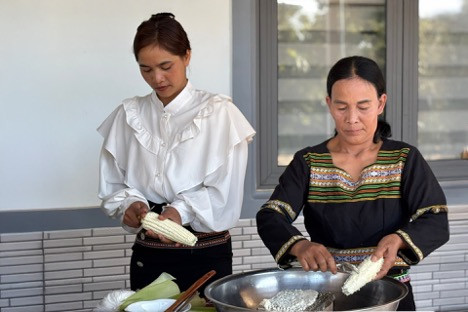
An Heirloom Dish
Ko Sa K’Tuyet, a resident of Cam Ly 6 residential group, recalls that she first learned about corn cakes when she was still a young girl. On every festive occasion—Christmas, New Year, or traditional celebrations—the K’ho Cil people of Ta Nung would make corn cakes. It is a traditional dish found in every household.
“The corn grown by the K’ho is glutinous corn, with yellow and purple kernels that are sticky and richly sweet,” K’Tuyet explained.
In the past, corn was usually planted during the dry season. Sowing began right after the Lunar New Year, and by May or June the corn was ready for harvest. At that time, every household in the village made corn cakes to offer to Yang (the deities) and to their ancestors. “Today, corn is available year-round, so at any festival throughout the year, the people of Ta Nung still make corn cakes,” K’Tuyet recalled.
Corn cakes are a traditional dish of the K’ho Cil people, one of the two main branches of the indigenous K’ho community living in Ta Nung. For generations, corn was the primary crop of the K’ho, especially during the dry season when water was scarce and rainfall insufficient for growing rice. Corn helped ensure fuller meals and warmer hearths during the lean months between harvests. Over time, the K’ho transformed corn into fragrant cakes to offer to their ancestors and the deities (Yang).
Today, the K’ho people of Ta Nung no longer rely on corn as a staple food. Their livelihoods have improved significantly with crops such as coffee, mulberry, vegetables, and flowers. Corn cakes have evolved into a cultural symbol and a local specialty of the communities living at the foot of the mountain pass. “At every festival, the K’ho people of Ta Nung must have corn cakes on the offering tray. At festivals, corn cakes are always enjoyed and highly praised,” K’Tuyet said with pride.
Versatile Hands of K’ho Women
At 61, Mrs. Mo Bon K’Pot, like many K’ho Cil women in Ta Nung, learned to make corn cakes as a child from her mother and grandmother. “Corn cakes are simple to make. You just need fresh corn and skillful hands,” she said.
According to Mrs. K’Pot, freshly harvested corn is peeled and grated into a paste using a simple perforated tin sheet. The corn paste is then placed back into corn husks, tied tightly, and steamed for about 30 minutes. The finished cakes are fragrant, lightly sweet, soft, and chewy, preserving the natural taste of glutinous corn.
In the past, corn kernels were pounded by hand, and cakes were wrapped not only in corn husks but also in dong or oil leaves. No seasoning was needed, as fresh corn was naturally sweet. Today, K’ho Cil women continue to pass these techniques down to younger generations, ensuring that corn cakes remain an essential offering at festivals—symbolizing gratitude to ancestors, a bountiful harvest, and the enduring traditions of the Ta Nung highlands.